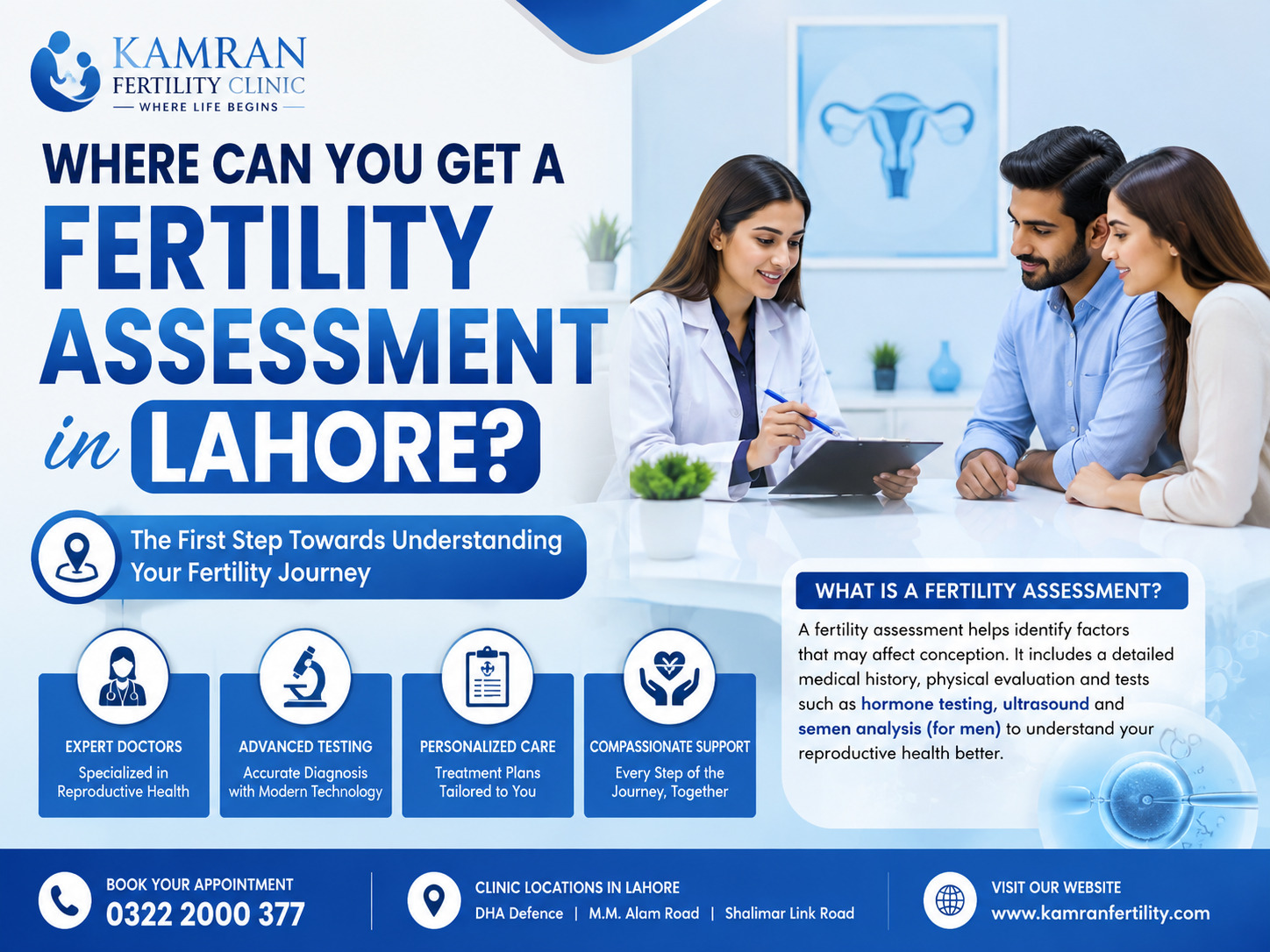
Where Can You Get a Fertility Assessment in Lahore?
If you are looking for a fertility assessment in Lahore, you may be unsure where to begin. Should you visit a gynecologist, a fertility specialist, a fertility clinic, or have fertility tests done at a laboratory first?
For most people, the better starting point is a consultation with a fertility specialist. The purpose of an assessment is to understand your medical and reproductive history, identify factors that may be affecting conception, and decide whether any investigations are actually needed.
A fertility assessment does not automatically mean IVF. It is the first step toward understanding your situation and deciding what to do next.
Where can you get a fertility assessment in Lahore?
Fertility assessments are available through fertility specialists, dedicated fertility clinics, and hospitals offering reproductive health services across Lahore.
When choosing a clinic, don’t focus only on whether it offers IVF or other fertility treatments. Look for a doctor who takes time to understand your history, considers both partners when appropriate, explains recommended tests, and discusses your options clearly.
Kamran Fertility Clinic in Lahore
At Kamran Fertility Clinic, Dr. Kamran Saleem provides fertility assessment and diagnosis for both men and women.
The clinic’s approach is to understand each patient’s situation before recommending investigations or treatment. Depending on your history and clinical needs, an assessment may include a review of previous reports and investigations such as hormone testing, ultrasound, or semen analysis when appropriate.
Kamran Fertility provides consultations at locations in Lahore, including DHA Defence, M.M. Alam Road, and Shalimar Link Road.
If you want to understand exactly what is included, see the Fertility Assessment & Diagnosis service.
What happens during a fertility assessment?
A fertility assessment usually begins with a detailed conversation rather than immediately ordering a long list of tests.
Your fertility specialist may ask about:
- How long you have been trying to conceive
- Your menstrual cycle and ovulation
- Previous pregnancies or pregnancy losses
- Previous fertility treatment
- Medical and surgical history
- Current medications
- Previous blood tests or ultrasound reports
- Male reproductive and sexual health, where relevant
This information helps the doctor determine which factors may need further evaluation.
A systematic fertility evaluation is designed to identify relevant causes while avoiding unnecessary investigations.
If you already have fertility reports, bringing them to your appointment can also help the doctor understand what has already been investigated.
What fertility tests might be recommended?
There is no single fertility test that everyone needs.
The appropriate investigations depend on your age, symptoms, medical history, previous results, reproductive history, and how long you have been trying to conceive.
Depending on the situation, a fertility specialist may consider:
Hormone testing
Blood tests may be recommended when there are concerns about ovulation, menstrual cycles, or other hormonal factors.
Ultrasound
An ultrasound can provide information about the uterus and ovaries and may help identify findings that require further assessment.
Ovulation assessment
Your menstrual history can provide important information about whether ovulation is likely occurring regularly. Additional testing may be recommended when clinically indicated.
Semen analysis
For men, a semen analysis is an important part of fertility evaluation. It can provide information about sperm concentration, movement, and morphology.
Male and female factors can both contribute to difficulty conceiving, so when applicable, both partners should be evaluated rather than assuming the issue is related to only one partner.
If you want to learn more about male fertility testing, read our guide to male fertility tests and semen analysis.
When should you get a fertility assessment?
You don’t necessarily need to wait until you have been trying for a specific amount of time if you already have a known or suspected fertility concern.
In general, infertility evaluation is considered after:
- 12 months of trying to conceive for women under 35
- 6 months for women aged 35 or older
- More immediate evaluation may be appropriate for women over 40
Earlier assessment may also be appropriate when there is a known condition or medical history that could affect fertility.
You may want to speak with a fertility specialist sooner if you have concerns such as:
- Irregular or absent periods
- Possible ovulation problems
- PCOS
- Endometriosis
- Previous pelvic or reproductive surgery
- Previous pregnancy losses
- Known sperm problems
- Previous fertility treatment
If you’re unsure whether it is the right time to seek help, you can also read When to Seek a Fertility Consultation.
Do you need a fertility assessment if your periods are regular?
Not necessarily.
Regular periods can provide useful information about ovulation, but they do not rule out every possible fertility factor.
Fertility can also involve sperm health, the fallopian tubes, uterus, reproductive anatomy, or other medical factors.
This is why a fertility assessment should consider the overall situation rather than relying on one symptom or test.
Does a fertility assessment mean you need IVF?
No.
A fertility assessment is about finding out what may be affecting your ability to conceive. Treatment is a separate decision.
Depending on the findings, the next step could involve further investigation, medical management, monitoring, or fertility treatment such as IUI, IVF, or ICSI when clinically appropriate.
The purpose of an initial consultation is to understand your options—not to assume that IVF is automatically necessary.
You can learn more about treatment options on the Fertility Treatment service page.
What should you look for when choosing a fertility clinic in Lahore?
When comparing fertility clinics or specialists, consider these questions:
- Does the doctor evaluate both male and female fertility when appropriate?
- Are recommended tests explained clearly?
- Does the doctor review previous reports?
- Are investigations recommended based on your individual situation?
- Can you ask questions and understand your options before deciding on treatment?
The quality of the initial consultation matters because fertility care is not simply about performing tests. It is about understanding what those tests mean and how the results should influence the next decision.
What should you take to your fertility consultation?
If you have previous medical records, take them with you. These may include:
- Blood test results
- Ultrasound reports
- Semen analysis reports
- Previous IVF, IUI, or ICSI records
- Pregnancy or pregnancy-loss records
- Relevant surgical reports
- Current medication information
You can also write down your questions before the appointment so you don’t forget anything important.
Fertility assessment in Lahore: where should you start?
If you are concerned about your fertility, you don’t necessarily need to start with IVF or order fertility tests yourself.
A consultation with a fertility specialist in Lahore can help you understand your reproductive history, consider relevant male and female factors, determine whether testing is appropriate, and discuss what the next step should be.
At Kamran Fertility Clinic, Dr. Kamran Saleem provides fertility assessment and diagnosis for men and women in Lahore.
If you are ready to understand your situation, you can learn more about the Fertility Assessment & Diagnosis service or contact the clinic to arrange a consultation.
FAQs
Where can I get a fertility assessment in Lahore?
You can get a fertility assessment from a fertility specialist, fertility clinic, reproductive health specialist, or hospital-based fertility service in Lahore. Choose a provider who can evaluate the relevant factors for both partners and explain why particular investigations may be needed.
What tests are included in a fertility assessment?
There is no fixed list of fertility tests for everyone. Depending on the individual situation, a doctor may recommend hormone testing, ultrasound, ovulation assessment, semen analysis, or other investigations.
Should both partners have a fertility assessment?
When applicable, yes. Male and female factors can both contribute to difficulty conceiving, so concurrent assessment of both partners is recommended in infertility evaluation.
Does having PCOS mean I need IVF?
No. PCOS can affect ovulation and fertility, but having PCOS does not automatically mean IVF is necessary. The appropriate approach depends on your individual circumstances.
Does a fertility consultation mean I have infertility?
No. A consultation is an opportunity to discuss your reproductive health and determine whether further assessment is appropriate. A doctor can explain whether your circumstances meet the criteria for an infertility evaluation.
Does a fertility assessment mean I need IVF?
No. Assessment comes before treatment. Depending on the findings, the next step may be monitoring, medical management, further investigation, IUI, IVF, ICSI, or another appropriate approach.