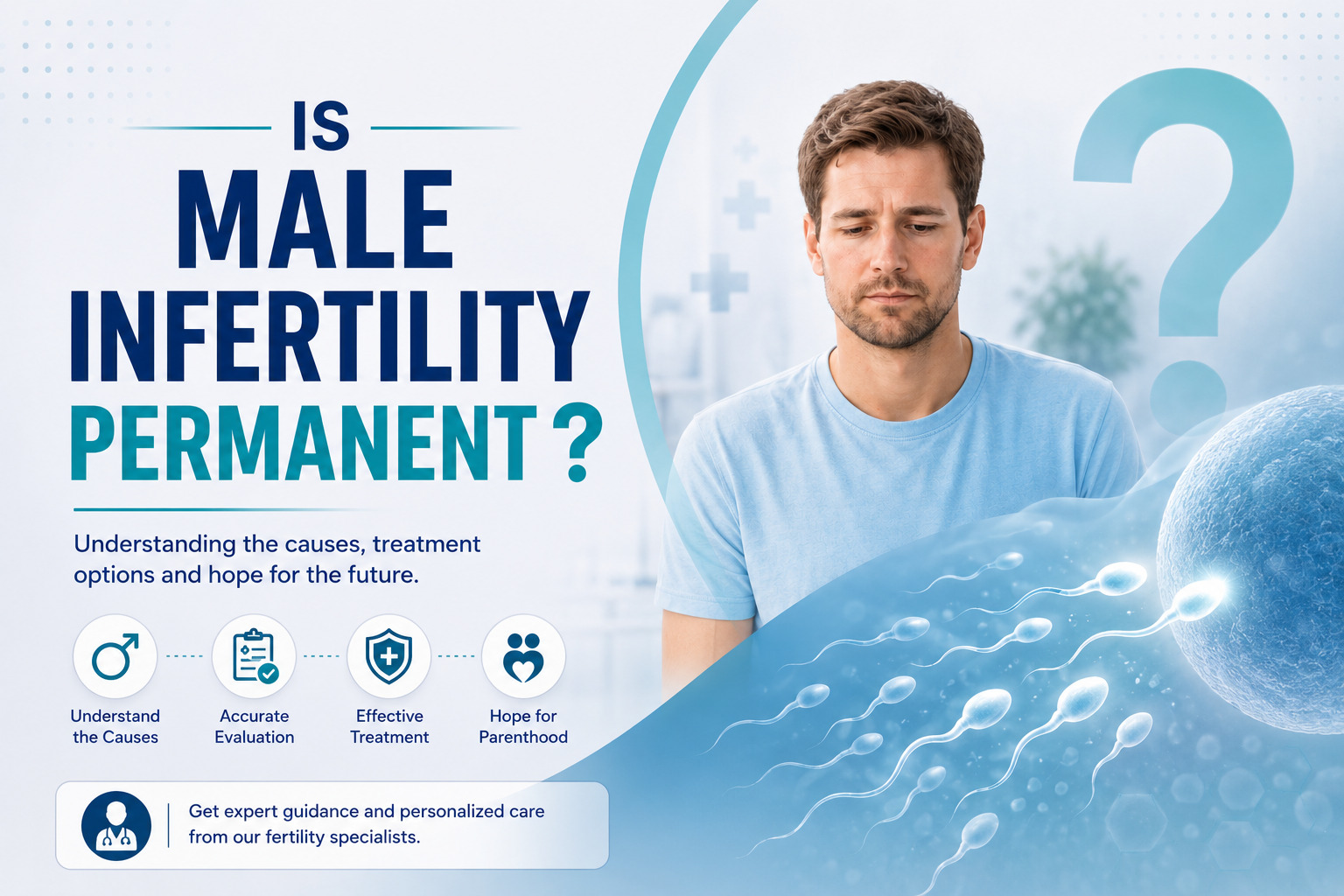
Is Male Infertility Permanent? Can It Be Reversed?
Is male infertility permanent? Not always.
Male infertility is not a single disease with one outcome. It can result from problems with sperm production, sperm quality, sperm transport, ejaculation, hormones, the testicles, genetics, infections, medications, or other health factors. Some causes can be treated or improved. Others may not be completely reversible but can still be managed with fertility treatment.
Even when sperm are not found in the semen, biological fatherhood may sometimes remain possible. In selected cases, sperm can be retrieved from the reproductive tract or testicle and used with assisted reproductive techniques such as in vitro fertilization (IVF) and intracytoplasmic sperm injection (ICSI).
The important question, therefore, is not simply “Is male infertility permanent?” It is:
What is causing the infertility, and is that cause reversible, treatable, manageable, or likely to be permanent?
A proper male fertility evaluation can help answer that question.
Quick answer: Is male infertility permanent?
Male infertility is not necessarily permanent.
The outlook depends on the underlying cause.
Some examples:
- Hormonal problems may respond to appropriate medical treatment.
- Certain infections can be treated, although fertility may not fully recover if permanent reproductive damage has occurred.
- A clinically significant varicocele may be treatable in appropriately selected men.
- A blockage in the reproductive tract may sometimes be surgically corrected.
- Medication- or steroid-related suppression of sperm production may improve after the underlying issue is medically addressed.
- Low sperm count or poor sperm motility may improve when a reversible cause is identified and treated.
- Azoospermia does not always mean that sperm production is completely absent; the cause needs to be established.
- Severe testicular damage, some genetic conditions, and certain forms of primary testicular failure may be difficult or impossible to reverse.
Even when natural fertility cannot be restored, treatment may still make biological parenthood possible in some cases.
What does “male infertility” actually mean?
Infertility refers to difficulty achieving a pregnancy despite regular unprotected intercourse.
The World Health Organization defines infertility as failure to achieve pregnancy after 12 months or more of regular unprotected sexual intercourse. Male factors can contribute to infertility alone or together with female factors.
Male infertility can involve:
- Low sperm concentration
- No detectable sperm in semen
- Poor sperm movement
- Abnormal sperm morphology
- Problems with sperm production
- Problems transporting sperm
- Ejaculation disorders
- Erectile or sexual difficulties
- Hormonal disorders
- Genetic conditions
- Testicular conditions
- Previous infections or injuries
- Certain medications or substances
WHO identifies abnormalities involving semen ejection, sperm quantity, sperm morphology and sperm motility among important male reproductive causes of infertility.
This is why an abnormal semen analysis should not automatically be interpreted as permanent infertility.
Can male infertility be reversed?
Sometimes.
Whether infertility can be reversed depends on why it is happening.
A useful way to think about male infertility is to divide causes into three broad groups:
1. Potentially reversible causes
These are problems where addressing the underlying cause may restore or improve fertility.
Examples can include certain:
- Hormonal disorders
- Medication-related effects
- Anabolic steroid or exogenous testosterone-related suppression
- Infections
- Lifestyle or environmental contributors
- Treatable obstructions
- Clinically significant varicocele in selected patients
2. Treatable or manageable causes
Some conditions cannot necessarily be “cured,” but treatment can improve the chances of conception.
For example, a man may continue to have impaired sperm production but have enough sperm available for assisted reproduction.
3. Causes that may be permanent
Some forms of:
- Severe testicular damage
- Primary testicular failure
- Certain genetic abnormalities
- Significant damage following chemotherapy or radiation
- Some severe forms of non-obstructive azoospermia
may not be fully reversible.
However, even in some of these situations, sperm retrieval or assisted reproductive treatment may still be considered.
Permanent infertility and inability to have a biological child are not always the same thing.
What determines whether male infertility is permanent?
A fertility specialist usually considers several factors rather than relying on one test.
These can include:
The underlying cause
A man with a correctable obstruction has a very different prognosis from someone with severe primary testicular failure.
Sperm production
Doctors need to determine whether the testicles are producing sperm.
Semen analysis
Sperm concentration, total sperm number, motility and morphology can provide important information about reproductive function.
Hormone levels
Hormones such as FSH, LH and testosterone can help identify certain problems involving the hormonal control of sperm production.
Testicular function
The condition and function of the testicles can affect whether sperm production can improve.
Genetic factors
Some genetic conditions can affect sperm production or the reproductive tract and may influence treatment decisions.
Previous treatment or injury
Previous chemotherapy, radiation, testicular surgery, trauma or infection may affect fertility.
The couple’s overall reproductive circumstances
Pregnancy involves both partners. The male factor should therefore be considered alongside the female partner’s age, ovarian function, reproductive health and other relevant factors.
Can low sperm count be reversed?
Sometimes, yes.
Low sperm count, or oligospermia, has many possible causes.
An improvement may be possible when the underlying cause is treatable. For example, fertility may improve after appropriate management of certain hormonal disorders, medication-related effects, varicocele or other contributing factors.
However, sperm counts can naturally fluctuate.
One abnormal semen analysis does not necessarily establish permanent infertility.
Doctors may recommend repeat testing and further evaluation depending on the initial result and the man’s clinical history.
More importantly, sperm concentration should not be considered alone. Motility, morphology, total sperm number and the couple’s reproductive circumstances also matter.
Can poor sperm motility be reversed?
Poor sperm movement is called asthenozoospermia.
Whether motility improves depends on the cause.
If a reversible medical, lifestyle, medication-related or structural factor is contributing to poor motility, addressing that factor may improve semen quality.
However, there is no single treatment that reliably restores sperm motility in every man.
If motility remains significantly impaired, assisted reproductive techniques may sometimes provide an effective way of using available sperm for conception.
Can abnormal sperm morphology be reversed?
Sperm morphology describes the size and shape of sperm cells.
Abnormal morphology may occur alongside low sperm concentration or poor motility.
A morphology result should not be interpreted in isolation.
A man with abnormal morphology is not automatically permanently infertile, and morphology alone does not determine whether pregnancy is possible.
A fertility specialist considers the complete semen analysis and the couple’s reproductive history before recommending treatment.
Is azoospermia permanent?
Not necessarily.
Azoospermia means that sperm are not detected in the ejaculate.
But there are different reasons why sperm may be absent.
Obstructive azoospermia
In obstructive azoospermia, the testicles may still produce sperm, but a blockage prevents sperm from reaching the semen.
Potential causes include abnormalities or obstruction involving the reproductive tract.
Depending on the cause, treatment may include:
- Surgical reconstruction in selected cases
- Sperm retrieval
- IVF with ICSI
Non-obstructive azoospermia
In non-obstructive azoospermia, sperm production itself is impaired.
Possible causes include:
- Severe testicular dysfunction
- Hormonal disorders
- Genetic abnormalities
- Previous chemotherapy or radiation
- Certain congenital conditions
- Other causes of impaired spermatogenesis
Some men with non-obstructive azoospermia may still have small areas of sperm production within the testicles.
This means that “no sperm in the semen” does not automatically mean “no sperm anywhere.”
Whether sperm retrieval is possible depends on the individual diagnosis.
Can a man with azoospermia have a biological child?
In some cases, yes.
This depends on why sperm are absent from the semen.
If sperm are being produced but cannot enter the ejaculate, they may sometimes be retrieved directly.
In selected men with impaired sperm production, a fertility specialist may also consider surgical sperm retrieval to look for usable sperm within the testicular tissue.
If viable sperm are obtained, ICSI can be used as part of IVF.
ICSI involves injecting a single sperm directly into an egg to assist fertilization.
Therefore:
Azoospermia does not automatically mean biological fatherhood is impossible.
But it also does not mean that sperm retrieval will always be successful.
A specialist evaluation is needed to determine the likely cause and realistic options.
Can varicocele-related male infertility be reversed?
A varicocele is an enlargement of veins within the scrotum.
Not every varicocele causes infertility, and not every man with a varicocele needs treatment.
In appropriately selected men with a clinically significant varicocele and infertility, treatment may improve semen parameters and may improve the likelihood of pregnancy.
The decision depends on the clinical examination, semen analysis and the couple’s circumstances.
The important point is that a varicocele can represent a potentially treatable contributor to male infertility rather than automatically indicating permanent infertility.
Can hormonal infertility be treated?
Yes, in some cases.
Sperm production is regulated by communication between the:
Hypothalamus → pituitary gland → testicles
Hormones such as FSH, LH and testosterone are involved in this reproductive system.
When infertility results from a specific hormonal disorder, treating the underlying problem may improve sperm production.
However, fertility treatment is highly dependent on the type of hormonal problem.
An important warning about testosterone
Men sometimes assume that taking testosterone will improve fertility because testosterone is a male reproductive hormone.
The opposite can happen.
Exogenous testosterone can suppress the hormonal signals required for sperm production and can substantially reduce sperm production in some men.
If you are trying to conceive, do not start, stop or change testosterone treatment without discussing it with a qualified clinician.
Can male infertility caused by infection be reversed?
Sometimes, but not always.
Infections involving the reproductive tract can affect fertility.
Treating an active infection is important, but treatment does not necessarily reverse damage that has already occurred.
For example, inflammation or scarring may interfere with sperm transport even after the infection itself has been treated.
The earlier the underlying problem is identified, the more clearly a clinician may be able to determine what treatment options remain.
Can male infertility after chemotherapy or radiation be reversed?
It depends on the treatment, dose, area treated and the individual’s testicular function.
Chemotherapy and radiation can damage sperm-producing cells.
Some men recover sperm production over time, while others experience prolonged or permanent impairment.
For men who are planning cancer treatment, fertility preservation should ideally be discussed before treatment begins, because sperm banking may be an important option when appropriate.
Men who have already undergone treatment can still discuss fertility evaluation and available reproductive options with a specialist.
Can lifestyle changes restore male fertility?
Lifestyle can influence reproductive health, but lifestyle changes should not be presented as a guaranteed cure.
Depending on the individual, useful measures may include:
- Stopping smoking
- Avoiding recreational drugs
- Avoiding anabolic steroids
- Reviewing testosterone use with a doctor
- Limiting excessive alcohol intake
- Maintaining a healthy weight
- Eating a balanced diet
- Staying physically active
- Managing relevant medical conditions
- Avoiding unnecessary exposure to reproductive toxins
- Addressing excessive heat exposure where appropriate
WHO’s current infertility guidance recognizes lifestyle interventions such as healthy diet, physical activity and tobacco cessation as part of fertility care.
But lifestyle measures cannot correct every cause of male infertility.
If a man has a significant hormonal, genetic, structural or testicular problem, lifestyle changes alone may not be sufficient.
How long does it take for male fertility to improve?
There is no universal timeline.
Sperm production is a continuous biological process, so improvements generally take time rather than occurring immediately after treatment or lifestyle changes.
The timeline depends on the cause.
For example, the expected course can differ when treating:
- A hormonal disorder
- An infection
- A varicocele
- Medication-related suppression
- A lifestyle-related factor
- A testicular disorder
Follow-up testing is therefore more useful than judging fertility based on symptoms alone.
A man should also be cautious about products that promise to “increase sperm count in days” or “cure infertility naturally.” A specific diagnosis should come before treatment.
Does one abnormal semen analysis mean permanent infertility?
No.
Semen parameters can vary between samples.
An abnormal result may indicate that further testing is needed, but it does not automatically tell you that infertility is permanent.
A semen analysis commonly evaluates:
- Semen volume
- Sperm concentration
- Total sperm number
- Motility
- Morphology
The interpretation should consider the complete result rather than focusing on one number.
If the result is significantly abnormal, a doctor may recommend repeat testing and additional evaluation to identify the underlying cause.
Can male infertility go away on its own?
It is better not to assume that it will.
Some temporary factors can affect semen quality, and semen parameters naturally fluctuate.
But persistent difficulty conceiving deserves evaluation.
For couples who have not achieved pregnancy after 12 months of regular unprotected intercourse, infertility evaluation is generally appropriate. Earlier assessment may be appropriate when there are known risk factors or reproductive concerns.
Examples include:
- Previous testicular injury
- Undescended testicle
- Testicular surgery
- Previous chemotherapy or radiation
- Known varicocele
- Sexual or ejaculation difficulties
- Very low or absent sperm
- Previous reproductive infection
- Testosterone or anabolic steroid use
- Known hormonal problems
- Known genetic conditions
How do doctors find out whether male infertility is permanent?
There is no single test called a “permanent infertility test.”
Instead, doctors investigate the cause.
1. Medical and reproductive history
The clinician may ask about:
- How long the couple has been trying
- Previous pregnancies
- Previous fertility problems
- Puberty and reproductive development
- Testicular injury
- Testicular surgery
- Undescended testicles
- Previous infections
- Medication use
- Testosterone or steroid use
- Chemotherapy or radiation
- Smoking and alcohol
- Recreational drugs
- Sexual function
- Ejaculation
- Family history
2. Physical examination
The examination may look for:
- Testicular abnormalities
- Varicocele
- Signs of hormonal disorders
- Structural abnormalities
- Other findings relevant to fertility
3. Semen analysis
Semen analysis is one of the most important initial investigations.
It helps assess the quantity and quality of sperm.
But semen analysis alone cannot always explain why a man has abnormal fertility.
4. Hormone testing
Depending on the clinical picture, testing may include:
- Testosterone
- FSH
- LH
- Prolactin
- Other hormones where clinically indicated
5. Genetic testing
Genetic testing may be appropriate in selected men, particularly those with severe impairment of sperm production or certain forms of azoospermia.
Genetic findings can influence treatment decisions and may have implications for reproductive counselling.
6. Imaging
Imaging is not automatically required for every man.
When clinically indicated, ultrasound or other imaging can help investigate structural abnormalities or suspected obstruction.
The goal is to use the right tests for the individual, rather than ordering every possible fertility test.
Does male infertility mean IVF is necessary?
No.
IVF is one treatment option, not an automatic consequence of male infertility.
Depending on the diagnosis, treatment may involve:
- Addressing an underlying medical condition
- Appropriate hormonal treatment
- Treating an infection
- Correcting a structural problem
- Varicocele treatment in selected cases
- Surgical correction of an obstruction
- Sperm retrieval
- IUI
- IVF
- IVF with ICSI
The appropriate treatment depends on the severity and cause of the male factor, as well as the female partner’s reproductive health and the couple’s preferences.
WHO’s 2025 infertility guideline emphasizes a progressive approach to fertility care, moving from simpler management strategies toward more complex treatments such as IUI or IVF when clinically appropriate.
What if no cause of male infertility is found?
Sometimes a man’s evaluation does not identify one clear explanation for abnormal fertility.
This may be described as idiopathic male infertility.
Not finding a single cause does not mean that treatment is impossible.
The fertility team can still consider:
- Semen parameters
- Reproductive history
- Female partner’s fertility
- Duration of infertility
- Previous treatment
- The couple’s preferences
- Whether assisted reproduction is appropriate
A diagnosis of unexplained or idiopathic infertility is therefore different from a diagnosis of “no chance of pregnancy.”
Does male infertility affect the chances of natural pregnancy?
It can, but the effect depends on the severity and cause.
For example, mild abnormalities in semen parameters may have a very different impact from complete absence of sperm.
Pregnancy also depends on female fertility, timing of intercourse, age, reproductive health and other factors.
This is why a semen analysis should not be interpreted as a simple yes/no fertility test.
Does the female partner need fertility testing too?
In many situations, yes.
Infertility can result from:
- Male factors
- Female factors
- A combination of male and female factors
- No identifiable cause
Evaluating only the man can therefore miss an important part of the couple’s fertility picture.
A couple’s evaluation should be individualized so that treatment is directed toward the factors that are actually affecting their chance of conception.
When should a man see a fertility specialist?
Consider a male fertility evaluation if pregnancy has not occurred despite regular unprotected intercourse, particularly after 12 months.
You may want to seek assessment earlier if you have:
- A history of testicular injury or surgery
- Undescended testicles
- A known varicocele
- Previous chemotherapy or radiation
- Very low or absent sperm
- Sexual or ejaculation problems
- Previous reproductive infections
- Testosterone or anabolic steroid use
- Known hormonal problems
- A known genetic condition
- A previous fertility problem
A fertility assessment is also reasonable if you simply have concerns about your reproductive health.
You do not have to wait until a year has passed when there is already a known risk factor.
What should you do if you have been told you are infertile?
First, do not assume that the diagnosis means permanent infertility.
Ask:
- What is the likely cause?
- Was the diagnosis based on one semen analysis or repeated testing?
- Are sperm being produced?
- Is there a hormonal problem?
- Is there a varicocele or obstruction?
- Could medication or testosterone be affecting sperm production?
- Is genetic testing appropriate?
- Can the underlying cause be treated?
- Could sperm retrieval be possible?
- Is natural conception still realistic?
- Would IUI, IVF or ICSI be appropriate?
- Does my partner also need an evaluation?
These questions can turn a frightening diagnosis into a clearer treatment plan.
Is male infertility permanent? The bottom line
Male infertility is not automatically permanent.
Some causes can be corrected or improved. Some can be treated but may require ongoing management. Others may cause permanent impairment of sperm production.
Even when natural fertility cannot be restored, biological fatherhood may still be possible for some men through sperm retrieval and assisted reproductive treatment.
The most important step is to identify what is causing the infertility.
An abnormal semen analysis, low sperm count or even azoospermia does not by itself tell you whether you can ever father a biological child.
Your prognosis depends on the underlying diagnosis.
Male fertility assessment in Lahore
If you are concerned about male infertility in Lahore, an individualized fertility assessment can help determine whether the problem may involve sperm production, sperm quality, hormones, sperm transport, ejaculation or another underlying factor.
Rather than assuming that infertility is permanent, the more useful question is:
What is causing it, and what options are available for your specific situation?
A fertility specialist can review your medical history, semen results and other relevant findings and help you understand the next appropriate step.
Frequently Asked Questions About Male Infertility
Can male infertility be cured permanently?
Sometimes the underlying cause can be corrected and fertility may improve. In other cases, infertility cannot be completely reversed but can be managed with fertility treatment.
Can a man with zero sperm have a baby?
Sometimes. Azoospermia has different causes. If sperm production is present, sperm retrieval may be possible in selected cases, followed by IVF with ICSI.
Can low sperm count become normal?
It can improve in some men when an underlying reversible cause is treated. However, not every case of low sperm count can be completely reversed.
Is azoospermia always permanent?
No. Obstructive azoospermia may be related to a correctable blockage, while some men with non-obstructive azoospermia may still have areas of sperm production. The cause must be investigated.
Can sperm come back after being absent?
In some situations, sperm production may recover after treatment of a reversible cause or after removal of a factor suppressing sperm production. Recovery is not guaranteed and depends on the diagnosis.
Can testosterone make a man infertile?
Yes. External testosterone can suppress the hormonal signals required for sperm production and may substantially reduce sperm production.
Can male infertility be treated without IVF?
Yes. Depending on the cause, treatment may include medical therapy, treatment of infection, surgery, correction of obstruction, varicocele treatment or other approaches. IVF/ICSI is not automatically required.
Can a man with poor sperm morphology have a baby?
Yes. Abnormal morphology does not automatically mean that natural pregnancy or biological fatherhood is impossible. The complete semen analysis and both partners’ fertility should be considered.
Can a varicocele cause permanent infertility?
A varicocele can affect sperm production in some men, but not every man with a varicocele becomes infertile. Selected men may benefit from treatment.
Can lifestyle changes fix male infertility?
Lifestyle changes can support reproductive health and may help when lifestyle factors contribute to poor semen quality. They cannot, however, correct every medical, structural, genetic or testicular cause.
How long does it take to improve sperm quality?
There is no universal timeframe. Sperm production takes time, and the expected response depends on the underlying cause and treatment.
Does one abnormal semen analysis mean I am infertile?
No. Semen parameters can vary between samples, and one abnormal result does not necessarily establish permanent infertility.
When should I see a male fertility specialist?
Evaluation is generally appropriate after 12 months of regular unprotected intercourse without pregnancy, and earlier when there are known risk factors, abnormal semen results or concerns about reproductive function.
Can male infertility be genetic?
Yes. Some genetic conditions can affect sperm production or the reproductive tract. Genetic testing may be appropriate in selected men with severe sperm-production problems.
Can male infertility affect the health of the man?
Some causes of male infertility can be associated with broader health conditions. A fertility assessment can therefore sometimes identify issues that deserve medical attention beyond conception.