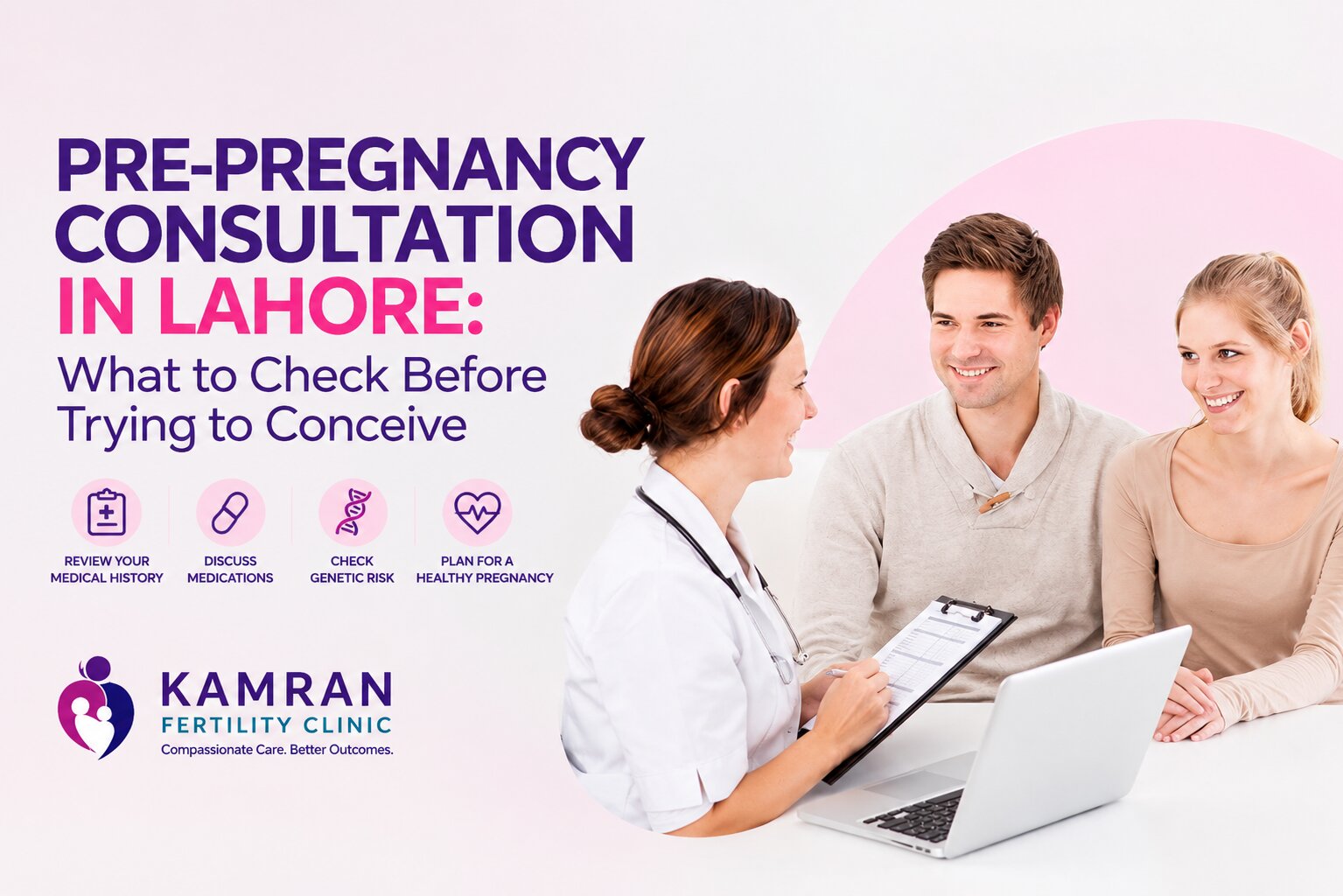
Pregnancy Consultation in Lahore: What to Know Before and Early in Pregnancy
Planning a pregnancy can bring many questions. Should you see a doctor before trying to conceive? Do you need tests if you feel healthy? What if you have already been trying for some time? And when does a pregnancy consultation become a fertility consultation?
A pregnancy consultation can help answer these questions before you make decisions about testing or treatment. For couples in Lahore, an early discussion with a qualified doctor can provide a clearer understanding of reproductive health, previous medical history, pregnancy planning, and whether any fertility concerns need further assessment.
Quick Answer
A pregnancy consultation in Lahore can be useful before conception, while planning a pregnancy, or during early pregnancy.
A pre-pregnancy consultation focuses on factors that may affect pregnancy and helps you prepare before trying to conceive. An early pregnancy consultation has a different focus, including reviewing your pregnancy history, health conditions, medicines, symptoms, and appropriate next steps.
If you have been trying to conceive without success, have irregular periods, experienced previous pregnancy loss, or have undergone fertility treatment, your consultation may also need to include a fertility assessment.
What Is a Pregnancy Consultation?
A pregnancy consultation is a medical discussion about preparing for pregnancy or receiving appropriate advice during early pregnancy.
Before conception, the doctor may review your medical history, menstrual and reproductive history, previous pregnancies, medicines, family history, lifestyle, and any known conditions that could affect pregnancy.
If you are already pregnant, the consultation may instead focus on your pregnancy history, current symptoms, existing medical conditions, medicines, and appropriate early pregnancy care.
The exact evaluation depends on your individual circumstances. Not everyone needs the same tests or investigations.
When Should You Have a Pre-Pregnancy Consultation?
You do not necessarily need to wait until you experience difficulty conceiving before seeking medical advice.
A pre-pregnancy consultation may be particularly useful if:
- You are planning to try for pregnancy soon.
- You have a medical condition that could affect pregnancy.
- You take regular prescription medicines or supplements.
- You have experienced a previous pregnancy loss or complication.
- Your menstrual cycles are irregular.
- You have been diagnosed with PCOS or another reproductive condition.
- You or your partner have concerns about fertility.
- You have previously undergone fertility treatment.
- You have questions about pregnancy at an older reproductive age.
- There is a relevant medical or genetic condition in your family.
A consultation does not automatically mean that you need fertility treatment. Sometimes the most useful outcome is simply understanding your health and what, if anything, should be addressed before trying to conceive.
If you are unsure whether it is the right time to seek specialist advice, you can also read Fertility Consultation: When Should You Seek Advice?.
What Happens During a Pregnancy Consultation in Lahore?
A consultation usually begins with your medical and reproductive history rather than immediately ordering a large number of tests.
Depending on your situation, the doctor may discuss several areas.
Menstrual and Reproductive History
Your menstrual pattern, previous pregnancies, pregnancy losses, and previous fertility treatment can provide important clinical context.
Irregular or absent periods, for example, can sometimes indicate that ovulation is not occurring regularly. This does not establish a diagnosis by itself, but it may indicate that further assessment could be useful.
Previous Pregnancies
If you have been pregnant before, the doctor may ask how those pregnancies progressed and whether there were complications.
Previous pregnancy outcomes can help determine whether additional evaluation or planning may be appropriate before another pregnancy.
Existing Medical Conditions
Conditions such as diabetes, thyroid disorders, hypertension, and other chronic health problems may need attention before pregnancy.
Managing a medical condition before conception can sometimes be different from managing it after pregnancy begins, so it is useful to discuss existing conditions with your doctor before trying to conceive.
Medicines and Supplements
Tell your doctor about prescription medicines, over-the-counter medicines, vitamins, and herbal supplements you take.
Some medicines may need to be reviewed before pregnancy. However, do not stop a prescribed medicine on your own. Discuss any changes with the doctor who is treating you.
Family and Genetic History
Your family history and your partner’s family history may sometimes raise questions about inherited conditions.
If there is a known genetic condition in the family, your doctor may recommend appropriate counselling, screening, or testing depending on the circumstances.
Lifestyle and Nutrition
A pre-pregnancy consultation can also provide an opportunity to discuss nutrition, physical activity, weight, smoking, alcohol or other substance exposure, and other factors that may influence pregnancy health.
The goal is not to make every couple follow the same checklist. Advice should be relevant to the individual’s health and circumstances.
Do You Need Tests Before Pregnancy?
Not everyone needs the same pre-pregnancy tests.
It is a common misconception that every couple planning a pregnancy needs a large panel of fertility tests.
The appropriate evaluation depends on factors such as age, medical history, menstrual pattern, previous pregnancy history, fertility history, symptoms, and how long you have been trying to conceive.
Depending on the situation, a doctor may consider:
- Blood tests
- Hormonal evaluation
- Assessment of ovulation
- Thyroid-related testing when indicated
- Ultrasound when clinically appropriate
- Semen analysis
- Review of previous medical investigations
- Genetic or infectious-disease screening when indicated
The purpose is not to order every available test. It is to identify investigations that could answer a relevant clinical question.
If you have already been trying to conceive or have specific fertility concerns, you can learn more about fertility assessment in Lahore and what an assessment may involve.
Is Pregnancy Consultation the Same as Fertility Consultation?
No. They can overlap, but they address different situations.
| Pregnancy Consultation | Fertility Consultation |
|---|---|
| Often focuses on preparing for pregnancy or early pregnancy | Focuses on difficulty conceiving or specific fertility concerns |
| Can take place before conception | Usually considered when there is a reason to assess fertility |
| Reviews health factors that may affect pregnancy | Evaluates possible factors affecting conception |
| May involve pregnancy planning | May involve fertility testing and treatment planning |
| Does not automatically mean infertility | May be appropriate when conception has been difficult |
There is also an important middle ground.
A couple may initially seek pregnancy planning advice and discover that a fertility assessment would be more appropriate based on their medical or reproductive history.
When Should You Consider a Fertility Consultation Instead?
If you have been trying to conceive without success, continuing to wait indefinitely may not always be the best approach.
A fertility consultation may be appropriate when there is:
- Persistent difficulty conceiving
- Irregular or absent periods
- A known reproductive condition
- Previous fertility treatment
- Recurrent pregnancy loss
- A concern about male fertility
- Previous abnormal fertility investigations
Both partners may need to be considered.
Fertility is not only a woman’s issue. Male factors can contribute to difficulty conceiving, which is why a proper fertility evaluation may consider both partners rather than focusing exclusively on the woman.
For couples who have already received a diagnosis or treatment recommendation elsewhere, a fertility treatment second opinion can also help clarify the reasoning behind a proposed next step.
What About an Early Pregnancy Consultation?
An early pregnancy consultation is different from a pre-pregnancy consultation.
Once pregnancy is suspected or confirmed, the focus shifts toward appropriate pregnancy assessment and care.
You should tell the doctor about:
- The date of your last menstrual period, if known
- Any previous pregnancies
- Previous pregnancy complications
- Existing medical conditions
- Current medicines and supplements
- Any significant symptoms
- Previous fertility treatment, if applicable
If you experience severe abdominal or pelvic pain, heavy bleeding, fainting, or another urgent symptom during pregnancy, seek prompt medical attention rather than waiting for a routine consultation.
Can a Fertility Specialist Help Before Pregnancy?
Yes, depending on why you are seeking advice.
A fertility specialist may be relevant before pregnancy when a couple has concerns about conception, previous fertility treatment, irregular cycles, reproductive health, or other factors that could affect their chances of conceiving.
For example, someone with irregular menstrual cycles may want to understand whether ovulation is occurring regularly. A couple who has previously undergone fertility treatment may want to review their options before trying again.
Importantly, seeing a fertility specialist does not automatically mean IVF or another treatment is required.
A sensible approach is to understand the underlying situation first and then discuss whether any investigation or treatment is actually appropriate.
Should Both Partners Attend the Consultation?
When fertility or conception is the main concern, having both partners involved can be useful.
This allows the doctor to consider both reproductive histories and reduces the risk of treating fertility as an issue affecting only one person.
Depending on the situation, male fertility assessment may include a semen analysis and, when appropriate, other investigations. Female evaluation may focus on menstrual history, ovulation, reproductive history, and other relevant factors.
For more information about male fertility testing, see Male fertility test: what it involves and what the results mean.
A semen analysis is one of the commonly used investigations when male fertility needs to be assessed. You can also read Understanding a semen analysis for a clearer explanation of what the test generally evaluates.
Pregnancy Consultation in Lahore: What Should You Bring?
You can make your consultation more useful by bringing relevant medical information with you.
Consider taking:
- Previous medical reports
- Previous ultrasound reports
- Fertility or hormone test results
- A list of current medicines and supplements
- Previous pregnancy records, if applicable
- Information about your menstrual cycle
- Previous fertility treatment records
- Relevant family medical history
You do not need to complete every possible fertility test before the appointment.
If you already have reports, bringing them can help the doctor understand what has already been investigated and whether further testing is actually necessary.
When Is a Second Opinion Worth Considering?
A second opinion can be useful when you are unsure about a diagnosis, treatment recommendation, or proposed next step.
For example, you may want another medical opinion if:
- You have been advised to proceed directly to IVF.
- You have received conflicting fertility advice.
- Previous treatment has not worked.
- You are unsure which investigations are necessary.
- You want to understand alternatives before making a decision.
- You want another doctor to review your previous reports.
A second opinion should not simply be about finding someone who promises a different outcome.
Its purpose is to help you understand the reasoning behind the recommendation, review the available information, and decide what options may be reasonable for your circumstances.
Frequently Asked Questions
When should I have a pre-pregnancy consultation?
You can arrange a consultation before you start trying to conceive. It may be particularly useful if you have an existing medical condition, previous pregnancy complications, fertility concerns, irregular periods, or questions about medicines or reproductive health.
Do I need fertility tests before trying for pregnancy?
Not necessarily. Fertility testing should be based on your medical and reproductive history rather than performed simply because you are planning a pregnancy.
Is pregnancy consultation only for women?
No. When conception is the main concern, both partners can be relevant to the assessment. Male fertility factors can also contribute to difficulty conceiving.
Can I have a pregnancy consultation if I have already started trying?
Yes. You do not necessarily need to wait until fertility treatment is being considered. A consultation can help determine whether continued attempts, an initial assessment, or a more detailed fertility evaluation is appropriate.
What is the difference between pre-pregnancy and early pregnancy consultation?
A pre-pregnancy consultation takes place before conception and focuses on preparing for pregnancy and identifying relevant health factors. An early pregnancy consultation takes place after pregnancy has begun and focuses on appropriate assessment and care.
Should I see a gynecologist or fertility specialist?
It depends on your reason for seeking care. General pregnancy or reproductive-health concerns may be appropriate for an obstetrician-gynecologist, while persistent difficulty conceiving or specific fertility concerns may warrant a fertility-focused assessment.
Can I get a fertility second opinion in Lahore?
Yes. A second opinion can be considered when you want another doctor to review previous investigations, a diagnosis, or a proposed fertility treatment plan before making a decision.
Does having a pregnancy consultation mean I need treatment?
No. A consultation is primarily an opportunity to understand your situation and discuss appropriate next steps. Treatment is not automatically required.
Pregnancy Consultation in Lahore: The Bottom Line
A pregnancy consultation can be useful well before a positive pregnancy test.
For couples planning to conceive, a pre-pregnancy discussion can help identify health factors that deserve attention and provide a clearer plan before trying.
If conception has already been difficult, the conversation may need to move from general pregnancy planning toward a more focused fertility assessment.
At Kamran Fertility Clinic, Dr. Kamran Saleem provides fertility-focused consultations in Lahore. The clinic’s Assessment & Diagnosis service is designed to help patients understand possible causes of fertility concerns and determine which investigations may be appropriate.
When treatment is indicated, Fertility Treatment options can be discussed based on the individual’s diagnosis rather than automatically recommending a particular procedure.
For patients who already have test results or a previous treatment plan and want another perspective, Support & Second Opinions provides an opportunity to review previous care and discuss reasonable next steps.
Dr. Kamran Saleem sees patients at Rasheed Hospital in DHA Defence, TAMC on M.M. Alam Road, and Shahnaz Hospital on Shalamar Link Road in Lahore.
If you are unsure which type of consultation is appropriate, you can discuss your situation with the clinic before deciding what to do next. Seeking advice does not mean that you have to commit to treatment.