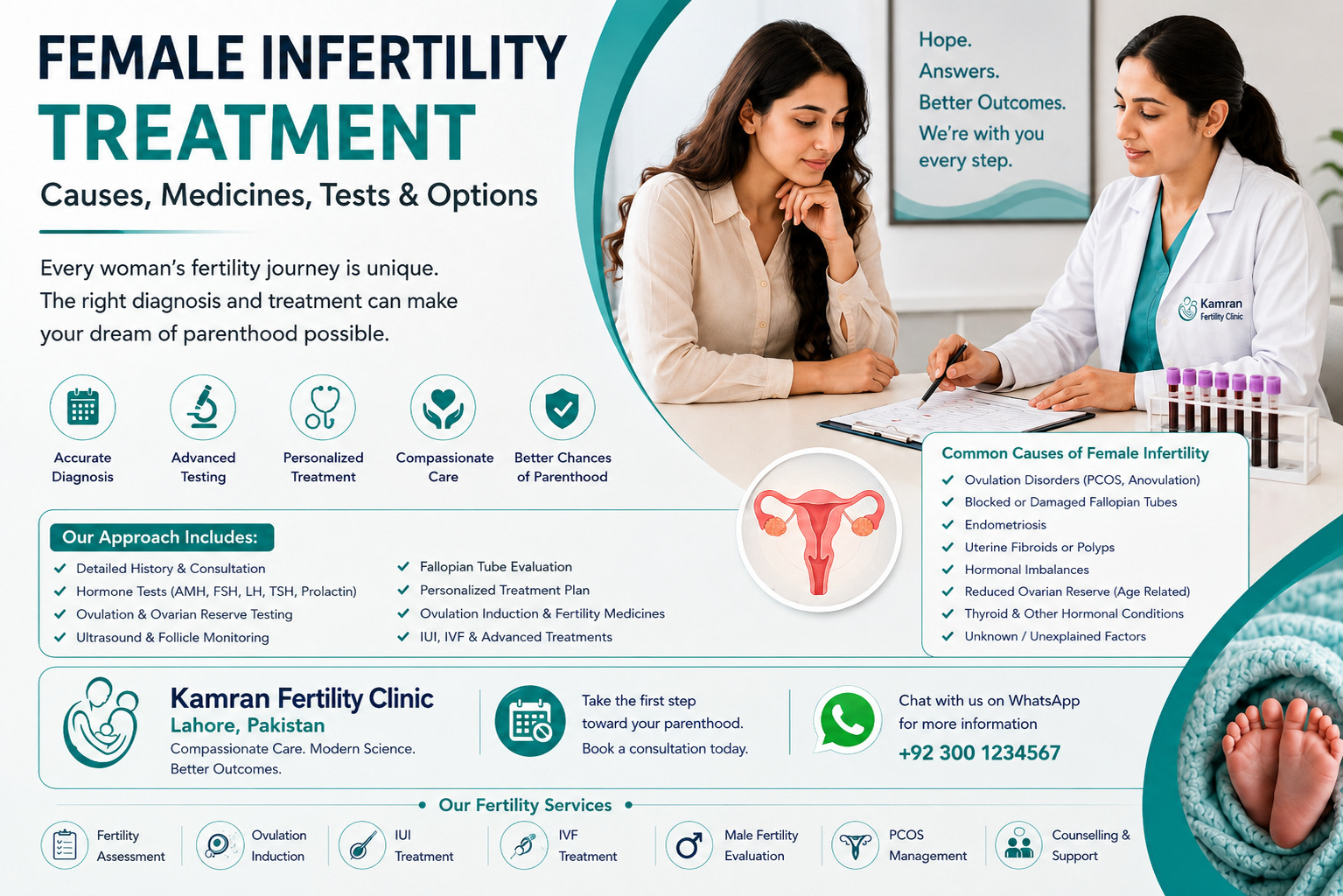
Female Infertility Treatment: Causes, Medicines, Tests and Options
Trying to conceive for months without success can leave you wondering what is going wrong. You may have regular periods, no obvious symptoms, and still have difficulty becoming pregnant. In other cases, irregular periods, endometriosis, blocked tubes, or problems with ovarian function may provide an important clue.
Female infertility treatment depends on the cause. Treatment may involve correcting an underlying condition, medicines that help ovulation, surgery in selected cases, intrauterine insemination (IUI), or in vitro fertilisation (IVF). The right approach should be based on a fertility assessment rather than choosing a medicine simply because it worked for someone else.
What is the best treatment for female infertility?
There is no single best fertility medicine or treatment for every woman. Doctors first look at ovulation, ovarian function, the uterus and fallopian tubes, age, medical history, and the male partner’s sperm where applicable. Treatment is then matched to the problem and the couple’s circumstances.
What causes female infertility?
Female infertility can result from problems involving the ovaries, fallopian tubes, uterus, or hormones. Sometimes more than one factor is present, and sometimes no clear cause is identified.
Common causes include:
- Ovulation problems: Irregular or absent ovulation can make it difficult for an egg to be released. Polycystic ovary syndrome (PCOS) is one possible cause.
- Blocked or damaged fallopian tubes: Previous pelvic infections, surgery, or other conditions can affect the tubes and prevent sperm and egg from meeting.
- Endometriosis: Tissue similar to the uterine lining grows outside the uterus and may affect fertility.
- Uterine problems: Fibroids, polyps, congenital abnormalities, or other changes inside the uterus can sometimes interfere with conception or implantation.
- Reduced ovarian reserve: The number and quality of available eggs generally decline with age.
- Hormonal conditions: Disorders involving the thyroid, pituitary gland, or other reproductive hormones can interfere with ovulation.
- Age: Female age is an important factor in fertility and should be considered when deciding how quickly to investigate and treat infertility.
Infertility is not always caused by the woman. Male factors can contribute to infertility, so evaluating both partners is important when a male partner is involved.
What are the symptoms of female infertility?
Infertility itself often has no obvious symptoms. The main sign is difficulty achieving pregnancy despite regular unprotected intercourse.
However, some women have symptoms that point toward a possible underlying problem. These can include:
- Irregular, very short, or absent periods
- Very painful periods
- Pelvic pain
- Symptoms associated with PCOS, such as excess facial or body hair
- Previous pelvic infection or reproductive surgery
- A history of conditions known to affect fertility
Having one of these symptoms does not automatically mean you are infertile. It means that medical assessment may be useful.
How is female infertility diagnosed?
A fertility evaluation usually starts with your medical and reproductive history. Your doctor may ask about menstrual cycles, previous pregnancies, pelvic infections, surgeries, medications, and conditions that could affect fertility.
Depending on your history, investigations may include:
- Ovulation assessment – menstrual history and, when needed, blood tests or ultrasound can help determine whether ovulation is occurring.
- Ovarian reserve assessment – tests such as AMH and antral follicle count can provide information useful for treatment planning. They do not independently predict whether a woman can become pregnant.
- Ultrasound – a transvaginal ultrasound can assess the uterus and ovaries.
- Fallopian tube assessment – tests such as hysterosalpingography (HSG) can assess whether the tubes are open.
- Hormonal testing – selected tests may be used when symptoms or menstrual patterns suggest an endocrine problem.
- Male fertility testing – when a male partner is contributing sperm, semen analysis should generally be part of the initial evaluation.
Not every woman needs every test. Good fertility care avoids unnecessary investigations and chooses tests according to the clinical history. If you want to understand exactly what is involved, see the Fertility Assessment & Diagnosis service.
What fertility medicine is used for women?
Fertility medicines are mainly used when ovulation is absent, irregular, or needs to be stimulated for a specific fertility treatment.
The appropriate medicine depends on the underlying diagnosis. Medicines used in fertility care can include oral ovulation-induction medicines and injectable gonadotropins. These treatments require medical supervision because the response of the ovaries needs to be monitored.
There is no universally “best fertility drug to get pregnant.” A medicine that is appropriate for one woman may be unsuitable for another, particularly when the cause of infertility is blocked tubes, severe endometriosis, reduced ovarian function, or a significant male factor.
For this reason, women should not start fertility medicine without assessment and appropriate medical advice.
What are the main female infertility treatment options?
Treatment can range from relatively simple interventions to assisted reproductive techniques.
Treating the underlying cause
If infertility is related to a condition that can be treated, addressing that problem may be the first step. Examples include managing hormonal disorders or treating selected uterine or tubal problems.
Ovulation induction
If a woman is not ovulating regularly, medication may be used to encourage ovulation. Treatment depends on why ovulation is irregular and may involve ultrasound monitoring.
Intrauterine insemination (IUI)
IUI places prepared sperm directly into the uterus around the fertile period. It may be considered in selected cases, depending on factors such as ovulation, tubal function, sperm quality, and the duration and cause of infertility.
In vitro fertilisation (IVF)
IVF involves stimulating the ovaries, collecting eggs, fertilising them with sperm in a laboratory, and transferring a resulting embryo into the uterus. It may be considered when other treatments are unsuitable or unsuccessful, or when the underlying fertility problem makes IVF more appropriate.
WHO’s current infertility guideline supports progressing from simpler management to treatments such as IUI or IVF according to the cause, clinical findings, and patient preferences. You can learn more about assisted options on the IVF treatment in Lahore page.
What about fertility treatment after age 40?
Fertility treatment after 40 needs particularly prompt and individualised assessment. Female age is an important predictor of fertility, and treatment decisions may need to be made more quickly rather than waiting for many months.
Testing may assess ovarian function, the uterus, fallopian tubes, and other relevant factors. Depending on the findings, treatment may involve ovulation treatment, IUI, IVF, or other approaches.
A fertility test cannot guarantee pregnancy. It helps the doctor understand the situation and choose a more appropriate treatment strategy.
When should you see a fertility specialist?
For women younger than 35, infertility evaluation is generally recommended after 12 months of regular unprotected intercourse without pregnancy.
For women aged 35 or older, evaluation is generally recommended after six months. Women over 40 may benefit from more immediate assessment. Evaluation should also begin sooner when there are irregular or absent periods, suspected endometriosis or tubal disease, previous fertility-threatening treatment, or another known risk factor.
Seeking help earlier does not mean you will automatically need IVF. It gives the doctor an opportunity to identify treatable problems before more time passes.
Female infertility treatment should involve both partners
It is still common for fertility problems to be treated as a woman’s issue. Medically, that is not an accurate way to approach infertility.
Infertility may involve female factors, male factors, both partners, or no clearly identifiable cause. When a male partner is contributing sperm, fertility evaluation should generally happen in parallel rather than investigating the woman alone.
Common myths about female infertility
| Myth | Fact |
|---|---|
| Infertility is usually the woman’s fault. | Fertility problems can involve either partner, both partners, or remain unexplained. |
| One fertility medicine works for everyone. | Treatment depends on the cause of infertility and the woman’s individual circumstances. |
| Regular periods guarantee normal fertility. | Regular cycles are reassuring but do not rule out tubal, uterine, ovarian, or male factors. |
| AMH alone can tell whether you can become pregnant. | Ovarian reserve tests can help with treatment planning but should not be treated as a standalone fertility test. |
| IVF is always the first treatment. | Many couples can be assessed and treated with simpler approaches when clinically appropriate. |
Female infertility treatment in Lahore: what should you do next?
Female infertility treatment works best when it begins with understanding why pregnancy has not occurred. Medicines can help some women with ovulation problems, while IUI, IVF, surgery, or treatment of an underlying condition may be more appropriate in other situations.
At Kamran Fertility Clinic in Lahore, Dr. Kamran Saleem, MBBS, Dip GUM & Ven (UK), can assess the relevant fertility factors and discuss treatment options based on the individual clinical picture.
If you are unsure which fertility test or treatment is appropriate, you can learn more about female and male infertility treatment or arrange an assessment with no obligation to proceed with treatment.
FAQs
What is the best fertility drug to get pregnant?
There is no single best fertility medicine. The appropriate medication depends on whether ovulation is irregular and what is causing the problem.
What is the fastest medicine to get pregnant?
No fertility medicine can guarantee pregnancy quickly. Treatment should be selected after identifying the likely cause of difficulty conceiving.
What are the main causes of female infertility?
Common causes include ovulation disorders, tubal problems, endometriosis, uterine conditions, reduced ovarian function, hormonal disorders, and age-related decline in fertility.
Can female infertility be treated without IVF?
Yes. Depending on the cause, treatment may include addressing an underlying condition, ovulation induction, or IUI. IVF is considered when it is clinically appropriate.
Can infertility be caused by both male and female factors?
Yes. Both partners can contribute to infertility, which is why simultaneous evaluation is often appropriate.
When should I get tested for infertility?
Women under 35 are generally advised to seek evaluation after 12 months of trying. At 35 or older, evaluation is generally advised after six months, while women over 40 may need earlier assessment.
Can blocked fallopian tubes cause infertility?
Yes. Blocked or damaged tubes can prevent sperm and egg from meeting and are a recognised cause of female infertility.
Does infertility always have a clear cause?
No. Some couples are diagnosed with unexplained infertility even after appropriate evaluation. Treatment can still be considered based on age, duration of infertility, test results, and individual circumstances.