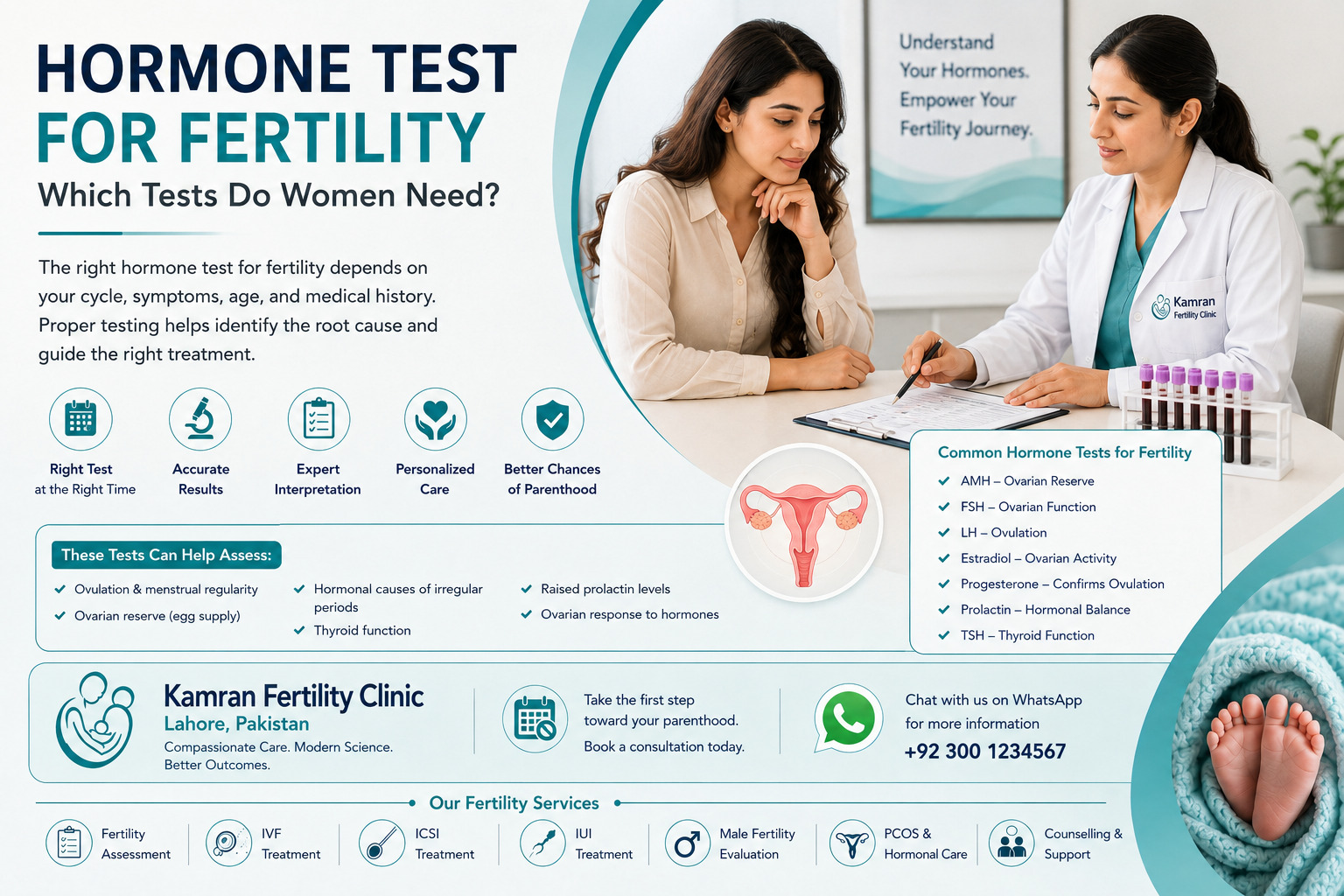
Hormone Test for Fertility: Which Tests Do Women Need?
Trying to understand your fertility can be confusing, especially when you see a long list of hormone tests online. Not every woman needs every test. The right hormone test for fertility depends on your menstrual cycle, symptoms, age, medical history, and how long you have been trying to conceive.
Hormone testing is one part of a wider fertility assessment. It can help a fertility specialist understand ovulation, ovarian function, menstrual problems, and conditions that may affect conception. At Kamran Fertility Clinic in Lahore, testing is interpreted alongside your history, examination, ultrasound findings, and, when appropriate, your partner’s fertility assessment.
Quick answer: What hormone tests are used for fertility?
Common hormone tests used during fertility testing for women include AMH, FSH, LH, estradiol, progesterone, prolactin, and thyroid-stimulating hormone (TSH). Each test answers a different question, and some are timed according to your menstrual cycle.
A hormone result should not be interpreted on its own. Your fertility specialist uses the complete picture to decide whether further testing or treatment is appropriate.
What does a female hormone test for fertility check?
A fertility test for women can look at several areas of reproductive health. Hormone testing may help assess:
- Whether ovulation is occurring regularly
- Ovarian reserve, which refers to the remaining egg supply
- Menstrual cycle problems
- Possible hormonal causes of irregular periods
- Thyroid function
- Raised prolactin levels
- How the ovaries are responding to reproductive hormones
The important point is that hormone tests do not provide a simple “fertile” or “infertile” result. Fertility is affected by several factors, including egg quality, fallopian tube health, the uterus, ovulation, age, and sperm health.
Which hormone tests are commonly used?
AMH — Anti-Müllerian Hormone
AMH is commonly used when assessing ovarian reserve. It is produced by small follicles in the ovaries and can provide information about the remaining pool of developing follicles.
AMH can be useful during a fertility assessment, particularly when planning fertility treatment. However, AMH does not directly measure egg quality and should not be treated as a stand-alone test of whether a woman can become pregnant naturally.
FSH — Follicle-Stimulating Hormone
FSH helps stimulate the development of ovarian follicles. A blood test may be used to assess ovarian function, usually alongside other hormone tests and clinical findings.
FSH levels can vary during the menstrual cycle, so the timing of testing matters. Your doctor may recommend testing on a particular cycle day depending on the reason for the assessment.
LH — Luteinizing Hormone
LH plays a key role in ovulation. A rise in LH helps trigger the release of an egg from the ovary.
Testing LH can be useful when investigating irregular periods or possible ovulation problems. LH is often interpreted together with FSH and other findings rather than in isolation.
Estradiol
Estradiol is the main form of estrogen during the reproductive years. It is produced mainly by the developing ovarian follicles.
When used as part of fertility tests, estradiol can provide additional information about ovarian activity and may help interpret other hormone results.
Progesterone
Progesterone rises after ovulation. Measuring progesterone at the appropriate time in the menstrual cycle can help determine whether ovulation has occurred.
Because progesterone changes significantly throughout the cycle, the timing of the blood test is particularly important.
Prolactin
Prolactin is a hormone involved in breast milk production. Abnormally high prolactin levels can interfere with normal reproductive function and may contribute to irregular or absent periods.
If menstrual cycles are irregular or there are other clinical reasons to suspect a prolactin problem, your doctor may recommend this test.
TSH — Thyroid-Stimulating Hormone
Thyroid function can affect menstrual cycles and reproductive health. TSH is commonly checked when there are symptoms or clinical reasons to investigate thyroid problems during fertility evaluation.
A thyroid problem does not automatically mean infertility, but identifying and managing an underlying disorder can be an important part of preconception care.
When should fertility hormone tests be done?
The best time depends on the hormone being tested.
Some reproductive hormones are commonly measured during the early part of the menstrual cycle, while progesterone testing is performed later when the goal is to assess ovulation. AMH can generally be measured at different points in the cycle, although your clinician will determine what is appropriate for your situation.
Do not choose testing dates based only on information from the internet. The correct timing depends on the purpose of the test and your menstrual pattern.
How do you test if a woman is infertile?
There is no single blood test that can confirm whether a woman is infertile.
A proper fertility test may involve several assessments, such as:
- Medical and reproductive history — Your doctor reviews menstrual cycles, previous pregnancies, surgeries, medications, and other relevant factors.
- Hormone testing — Blood tests may assess ovulation, ovarian reserve, thyroid function, or other hormones.
- Ultrasound — Pelvic ultrasound can examine the uterus and ovaries and may help assess developing follicles.
- Assessment of the fallopian tubes — When appropriate, testing may be recommended to determine whether the tubes are open.
- Male fertility assessment — A semen analysis can assess sperm count, movement, and shape.
This broader approach matters because infertility can involve female factors, male factors, both partners, or sometimes remain unexplained.
Does a normal hormone test mean fertility is normal?
No. Normal hormone results are reassuring in some situations, but they do not assess every part of fertility.
For example, hormone testing cannot by itself confirm that the fallopian tubes are open or that sperm can successfully fertilize an egg. It also cannot provide a direct measurement of egg quality.
That is why fertility specialists consider hormone results alongside ultrasound, medical history, age, and other appropriate investigations.
When should you consider fertility testing?
Consider discussing a fertility assessment with a specialist if you have been trying to conceive without success, have very irregular or absent periods, have a history of conditions or procedures that may affect fertility, or have concerns about your reproductive health.
You do not necessarily need to wait for a fixed period if there is already a known fertility concern. A specialist can advise you based on your individual circumstances.
Myths and facts about fertility hormone tests
| Myth | Fact |
|---|---|
| AMH tells you whether you can get pregnant. | AMH mainly provides information about ovarian reserve and does not directly predict natural pregnancy. |
| One abnormal hormone result means infertility. | Results need to be interpreted in context and may require further assessment. |
| Fertility testing is only for women. | Male factors can also contribute to difficulty conceiving, so both partners may need evaluation. |
| Every woman needs the same hormone tests. | Testing should be selected according to medical history, symptoms, cycle pattern, and clinical needs. |
Your next step
If you are concerned about your fertility, avoid ordering a long list of hormone tests without medical guidance. The useful test is the one that answers a specific clinical question, and timing can affect how results are interpreted.
Dr. Kamran Saleem, MBBS, Dip GUM & Ven (UK), at Kamran Fertility Clinic in Lahore can assess your history and recommend the investigations that are appropriate for you and your partner.
This article provides general medical information and is not a substitute for an individual consultation or diagnosis. If you would like to discuss your fertility concerns, you can contact the clinic through WhatsApp without any obligation to book treatment.
FAQs
What is the most important hormone test for female fertility?
There is no single “most important” hormone test for every woman. AMH, FSH, LH, estradiol, progesterone, prolactin, and TSH may each be useful for different clinical questions.
Can a blood test show if I am fertile?
No blood test can give a complete yes-or-no answer about fertility. Hormone tests provide information about specific aspects of reproductive function.
Is AMH a fertility test?
AMH is mainly a marker of ovarian reserve. It can help a fertility specialist understand the expected ovarian response during some fertility treatments, but it does not directly measure egg quality or guarantee natural conception.
Can irregular periods be related to hormones?
Yes. Irregular or absent periods can sometimes be associated with hormonal or ovulatory problems. A fertility specialist may recommend hormone testing and other investigations to identify the possible cause.
Do men need fertility testing too?
Yes. Fertility problems can involve either partner, so evaluating both partners can provide a more complete picture. Semen analysis is a common first-line assessment of male fertility.
Where can I get a fertility assessment in Lahore?
Kamran Fertility Clinic’s Assessment & Diagnosis service can provide a structured evaluation based on your individual fertility concerns.
Suggested Internal Links
- Fertility Assessment & Diagnosis in Lahore — primary service page
- IVF Treatment in Lahore — relevant next-step treatment resource
- ICSI Treatment in Lahore — relevant where male-factor fertility issues are identified
Recommended Schema Types
- MedicalWebPage
- Article
- FAQPage
- Physician
- MedicalClinic
- BreadcrumbList
Primary Service Supported
Assessment & Diagnosis — this article supports the service by explaining why hormone testing is only one component of a complete fertility evaluation and helping patients understand what to expect before consultation.