ICSI Treatment in Lahore: Procedure, Cost, Benefits and Success Factors
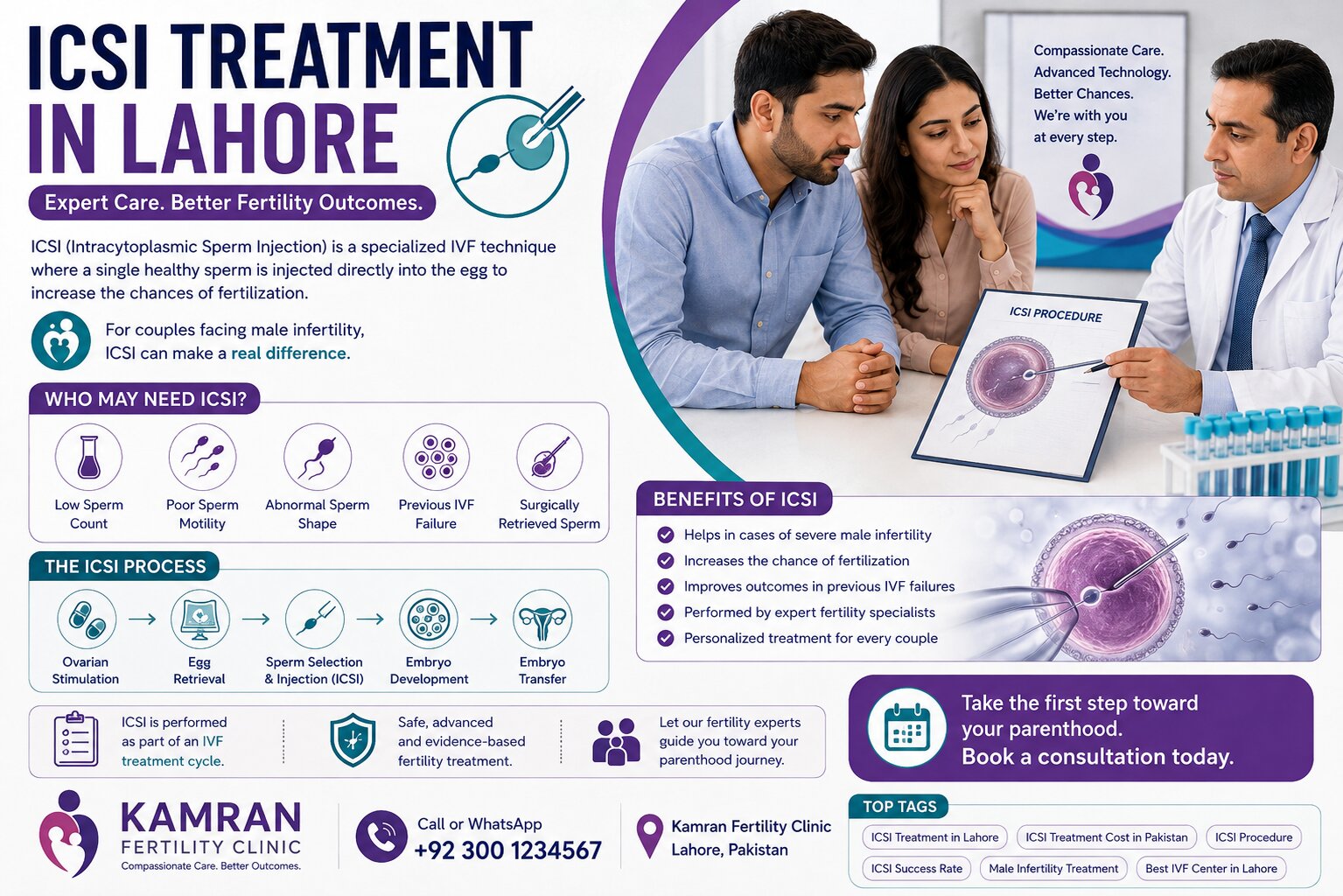
If you are exploring fertility treatment in Lahore, you may have heard about ICSI treatment alongside IVF. ICSI, or intracytoplasmic sperm injection, is a specialised laboratory technique used during IVF. It involves injecting a single sperm directly into a mature egg to help achieve fertilisation.
ICSI is particularly relevant when there is a significant male-factor infertility problem, such as very low sperm numbers, poor sperm movement, or certain sperm abnormalities. It may also be considered after previous IVF resulted in low or failed fertilisation.
For couples considering ICSI treatment in Lahore, the right approach starts with understanding the cause of infertility rather than assuming ICSI is necessary for every IVF cycle.
How does ICSI work?
ICSI is performed as part of an IVF cycle. Eggs are collected after ovarian stimulation, and an embryologist selects a sperm and injects it directly into a mature egg. If fertilisation occurs, the resulting embryo can continue developing in the laboratory before an embryo transfer is considered.
The technique can help overcome certain barriers to fertilisation, particularly when sperm quality or previous fertilisation results are a concern.
Who may need ICSI treatment?
ICSI may be recommended when there is a significant sperm-related problem or a previous IVF cycle resulted in poor or failed fertilisation.
Some situations in which a fertility specialist may consider ICSI include:
- Very low sperm count: may make natural fertilisation in the laboratory difficult.
- Poor sperm motility: sperm do not move effectively toward the egg.
- Significant abnormalities in sperm morphology: changes in sperm shape can affect fertilisation.
- Severe male-factor infertility: certain cases require direct assistance with fertilisation.
- Surgically retrieved sperm: sperm obtained through a surgical procedure rather than ejaculation.
- Previous IVF with low or failed fertilisation: ICSI may be considered for a subsequent cycle.
The decision should be based on the couple’s fertility assessment and laboratory findings. ICSI is not automatically better than conventional IVF for everyone. Current guidance from the American Society for Reproductive Medicine does not recommend routine ICSI when there is no male-factor infertility or previous fertilisation failure.
That distinction matters because the goal of fertility treatment is ultimately a healthy pregnancy and live birth, not simply achieving fertilisation in the laboratory.
What happens during the ICSI procedure?
The ICSI procedure takes place within an IVF treatment cycle. While the exact treatment plan differs between patients, the laboratory part generally follows these stages:
- Fertility assessment – before treatment, the fertility specialist evaluates both partners. Depending on the medical history, this may include a semen analysis, hormonal assessment, ultrasound and other fertility investigations. A semen analysis can provide information about sperm count, movement and morphology.
- Ovarian stimulation – medication is used during an IVF cycle to encourage the development of multiple eggs. The response is monitored by the fertility team.
- Egg collection – when the eggs are ready, they are collected using an established IVF procedure. Only mature eggs are suitable for ICSI.
- Sperm injection – the defining step of ICSI. Instead of placing sperm around the egg and allowing fertilisation to occur naturally in the laboratory, an embryologist uses specialised equipment to inject one selected sperm directly into the egg.
- Embryo development – the fertilised eggs are monitored as they develop into embryos. The fertility team determines the appropriate next step based on embryo development and the individual treatment plan.
- Embryo transfer – when appropriate, an embryo may be transferred into the uterus. The timing and approach depend on the clinical circumstances and treatment plan.
What is the difference between IVF and ICSI?
IVF and ICSI are not completely separate fertility treatments. ICSI is a fertilisation technique used within IVF.
| IVF with conventional fertilisation | IVF with ICSI |
|---|---|
| Eggs and prepared sperm are placed together in the laboratory | A single sperm is injected directly into a mature egg |
| Fertilisation occurs without direct sperm injection | The embryologist actively assists fertilisation |
| Often used when sperm parameters are suitable | Often considered when significant sperm problems or previous fertilisation failure exist |
| Does not require sperm injection into each egg | Requires specialised laboratory equipment and expertise |
The rest of the IVF process, including ovarian stimulation and egg collection, is broadly similar.
This is why the question is not simply “Is ICSI better than IVF?” A more useful question is whether ICSI is clinically appropriate for your particular fertility situation.
What affects ICSI treatment success?
There is no single ICSI success rate that applies to every couple. Outcomes depend on several factors, including the underlying cause of infertility, age, egg and sperm characteristics, embryo development and previous treatment history.
A fertility specialist may therefore assess:
- Age and reproductive history
- Ovarian response and egg numbers
- Sperm count, motility and morphology
- Cause and duration of infertility
- Previous IVF or ICSI outcomes
- Embryo development
- Other medical or reproductive factors
It is also important to distinguish fertilisation rate from pregnancy or live-birth outcomes. Higher fertilisation does not automatically mean a higher chance of having a baby. Current ASRM guidance specifically highlights this distinction when evaluating ICSI.
For this reason, patients should be cautious about fertility clinics or websites that present one fixed ICSI success percentage as though it applies to everyone.
How much does ICSI treatment cost in Pakistan?
The ICSI treatment cost in Pakistan varies because ICSI is usually performed as part of an IVF cycle rather than as a completely separate treatment.
The total cost may depend on:
- Fertility consultation and investigations
- Ovarian stimulation medicines
- Monitoring and scans
- Egg collection
- Laboratory and embryology services
- ICSI laboratory procedure
- Embryo culture
- Embryo transfer
- Freezing or storage, where applicable
- Additional investigations or procedures recommended for an individual patient
Therefore, the ICSI treatment cost in Lahore can only be estimated accurately after understanding the patient’s treatment plan and what is included in the clinic’s package.
A good consultation should make clear which services are included and which may involve additional charges.
Is ICSI suitable for every couple?
No. ICSI is a specialised technique, and it is not automatically required for every person undergoing IVF.
For couples with clear male-factor infertility or previous fertilisation failure, ICSI may have an important role. For couples without these indications, current evidence does not support routinely adding ICSI simply because it is a more advanced technique.
The best fertility treatment is therefore the one that matches the medical findings rather than the treatment that sounds most advanced.
Choosing ICSI treatment in Lahore
When comparing a fertility center in Lahore, look beyond the advertised success rate or treatment price.
Consider whether the clinic provides:
- A proper fertility assessment before treatment
- Evaluation of both male and female fertility factors
- Qualified fertility and reproductive medicine professionals
- Experienced embryology laboratory staff
- Clear explanations of treatment options
- Transparent information about treatment costs
- Appropriate follow-up and patient support
For ICSI, the embryology laboratory is particularly important because the procedure requires specialised equipment, skills and laboratory handling.
At Kamran Fertility Clinic in Lahore, Dr. Kamran Saleem, MBBS, Dip GUM & Ven (UK), can review your fertility history and discuss whether ICSI is an appropriate part of your treatment plan. ICSI can be an important option for couples facing significant male-factor infertility or previous fertilisation problems, but it should not be viewed as a guaranteed or universally superior form of IVF.
FAQs
Is ICSI better than IVF?
ICSI is actually a fertilisation technique used during IVF. It can be particularly useful when male-factor infertility or previous fertilisation failure is present. It is not routinely better for every couple.
Is ICSI used for low sperm count?
Yes. ICSI may be considered when sperm numbers are very low or other significant sperm abnormalities make conventional fertilisation more difficult.
How long does ICSI treatment take?
The overall duration depends on the IVF protocol, ovarian response, egg collection, embryo development and whether a fresh or frozen embryo transfer is planned. Your fertility specialist can provide a personalised timeline.
What tests are needed before ICSI?
Testing varies between couples. A fertility evaluation may include semen analysis, reproductive history, hormone testing, ultrasound and other investigations based on the findings.
Does ICSI guarantee pregnancy?
No. ICSI can assist the fertilisation stage, but fertilisation does not guarantee embryo implantation, pregnancy or live birth. Treatment outcomes vary between individuals.
How much does ICSI cost in Lahore?
There is no single price that applies to every patient. The total cost depends on the IVF cycle, medicines, laboratory procedures, investigations and any additional treatment required.