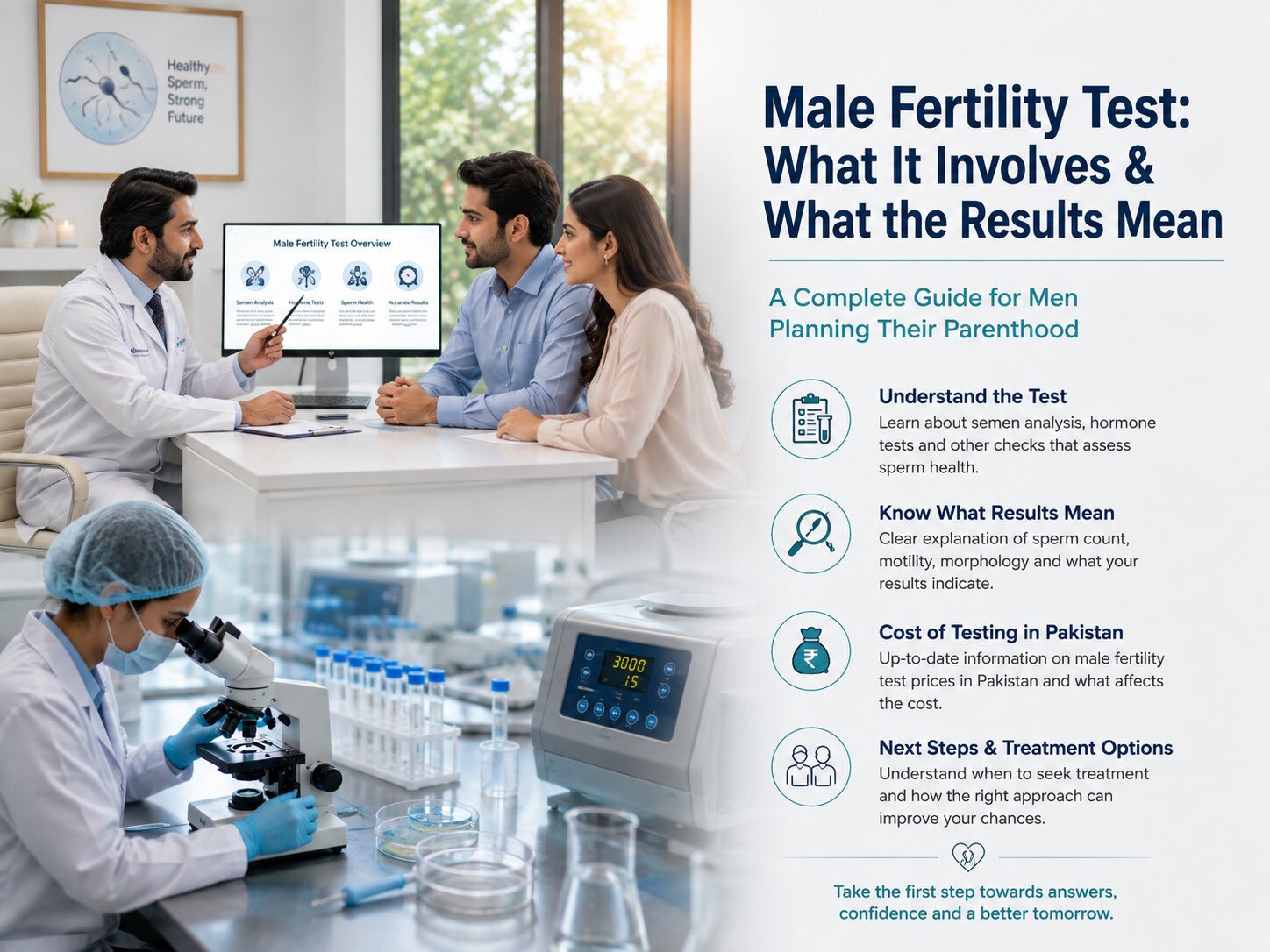
If you and your partner have been trying to have a baby, you may wonder whether sperm health could be part of the picture. Many men delay testing simply because they are not sure what a male fertility test actually involves. In most cases, the first step is straightforward: a semen analysis, which checks sperm count, movement, and shape. Depending on the results and your medical history, a doctor may recommend other tests from there.
What a male fertility test actually checks
A male fertility test is a group of checks used to see whether male reproductive factors could be affecting a couple’s chances of pregnancy. The first and most common test is a semen analysis, which looks closely at the sperm and semen in a sample. Other tests, such as hormone blood tests or imaging, are only added if the semen analysis is abnormal or the medical history points to something specific. Fertility testing is generally done for both partners when a couple is having difficulty conceiving, since this gives a doctor a clearer overall picture.
You may hear a semen analysis referred to by a few different names — sperm test, sperm count test, semen test, or seminogram. They all generally mean the same thing: a lab assessment of semen and sperm quality, not just a raw count.
A semen analysis usually looks at:
- Sperm concentration — the number of sperm in each millilitre of semen
- Total sperm number — the total sperm count across the full sample
- Sperm motility — how well the sperm move
- Sperm morphology — the size and shape of the sperm
- Semen volume — the amount of semen produced
- Other semen characteristics — additional features that help a doctor interpret the overall result
Sperm count matters, but it is only one part of the picture — motility and morphology matter just as much.
What the results actually mean
A semen analysis report can list several numbers at once, which is often confusing the first time you see it. The results are generally meant to be read together, rather than judged on any single figure.
A lower sperm count can reduce the chance of sperm reaching an egg, but it does not automatically mean pregnancy is impossible. Motility describes how well sperm move — they need to travel effectively through the reproductive tract to reach the egg, and a report may break this down into different movement categories. Morphology describes the shape and structure of sperm, assessed against established laboratory criteria, and like the other measures, it should not be judged in isolation. Semen volume is simply the amount produced in the sample, and any result outside the expected range is usually considered alongside the other findings rather than on its own.
It’s worth saying clearly: one abnormal result does not mean infertility. Semen results can vary between samples, and a doctor may ask for a repeat test before drawing any conclusion. Your medical history, a physical examination, and your partner’s own fertility assessment all factor into the full picture too. The World Health Organization provides standardised laboratory guidance for semen testing, but even by that standard, a semen analysis on its own cannot prove whether a man is fertile or infertile — it’s one piece of a larger assessment.
When other tests might be needed
Most men do not need every fertility test available. Additional testing is usually only suggested when the semen analysis or your medical history points to something specific.
Hormone blood tests may be used if there are signs of a hormonal issue or certain patterns in the semen results. Depending on the situation, this can include testosterone (the main hormone involved in male reproductive function), FSH (which helps regulate sperm production), and LH (which helps regulate testosterone production). Together, these can help explain why sperm production might be affected, not just confirm that it is.
A scrotal ultrasound is not routine for every man — it’s used selectively, usually to investigate a suspected physical issue such as a varicocele (enlarged veins around the testicle). Which tests you actually need depends on your individual history and examination, not a fixed checklist.
Home test kits vs a lab semen analysis
Male fertility test kits for home use do exist, and some can estimate sperm concentration through a basic strip or device. They can offer a rough first impression, but they have real limits — most home kits don’t assess sperm movement or shape, which matter just as much as count. If you’re seriously concerned about fertility, a laboratory semen analysis gives a far more complete picture. A home kit can be a useful starting point, but it shouldn’t be used to diagnose infertility on its own.
Is there a way to check fertility naturally, without testing?
Not reliably. There’s no way to confirm male fertility just by looking at semen, sexual performance, or physical appearance — a proper assessment needs actual testing. That said, some signs can make it reasonable to speak with a doctor sooner rather than later:
- Testicular pain, swelling, or a lump
- Previous testicular or groin surgery, or injury
- Problems with sexual function
- Certain long-term health conditions
- A history of treatments or medicines that may affect fertility
None of these prove a fertility problem on their own — and plenty of men with none of these signs still turn out to have abnormal results. They’re simply reasons to consider testing sooner.
What it costs in Pakistan
Pricing for a male fertility test varies by laboratory, city, and exactly which tests are included — a basic semen analysis generally costs less than a full assessment with additional hormone testing. There’s no single figure that applies everywhere, so before booking, it’s worth asking the lab or clinic directly: what’s included in the price, whether it’s a basic semen analysis or something more, whether extra tests are charged separately, whether a doctor’s consultation is included, and when results will be ready.
At Kamran Fertility Clinic in Lahore, Dr. Kamran Saleem explains which tests are actually appropriate for your situation before anything is booked, and what each one is meant to assess — so there are no surprises on cost or on necessity.
When it’s worth getting tested
A general guideline is to consider testing after a year of trying to conceive without success, or sooner — around six months — if your partner is over 35. That said, testing earlier is entirely reasonable if you have any of the risk factors above, a history of testicular or groin issues, previous fertility problems, or you’d simply like clarity before trying at all. You don’t need to wait out a full year if there’s already a clear reason to look into it sooner.
What happens after the results
What comes next depends entirely on what the results show. If the semen analysis is within the expected range, a doctor will usually look at other possible factors if pregnancy still hasn’t occurred. If something is outside the expected range, the usual next step is a repeat test, followed by a conversation about what might be driving it and what fertility treatment options — from lifestyle changes to IUI or IVF with ICSI — might be relevant, depending on the cause. An abnormal result is a starting point for that conversation, not a final diagnosis.
A semen analysis vs a full fertility assessment
These are related but not the same thing. A semen analysis is usually the starting test — it checks sperm and semen characteristics and can point toward a possible male-factor issue, but it doesn’t diagnose fertility by itself. A full fertility assessment looks at the wider picture: medical history, physical examination, and any further testing needed, giving a broader basis for what to do next. Because conceiving involves both partners, doctors will often suggest assessing both together rather than one in isolation.
Common myths, and what’s actually true
- Myth: A normal erection means you’re fertile. Fact: Sexual function and sperm production are controlled separately — a man can have completely normal erections and still have abnormal sperm parameters.
- Myth: A low sperm count means you can’t have children. Fact: It can reduce the odds, but it doesn’t automatically rule out natural conception.
- Myth: Fertility testing is only for women. Fact: Male factors are a common contributor to difficulty conceiving, and semen analysis is a core part of the initial workup.
- Myth: A home kit is the same as a lab test. Fact: Home kits usually only estimate sperm concentration; a lab semen analysis covers several parameters at once.
- Myth: One abnormal result proves infertility. Fact: Results vary sample to sample — doctors typically recommend a repeat test before drawing any conclusion.
A few common questions
What’s the main test used to check male fertility?
A semen analysis — it checks sperm concentration, total count, movement, shape, and other semen characteristics.
What’s this test usually called?
Most commonly, a semen analysis. You may also hear sperm test, sperm count test, semen test, or seminogram.
How much does it cost in Pakistan?
It varies by lab and by what’s included — a basic semen analysis generally costs less than a full assessment. It’s worth confirming current pricing directly with the clinic or lab before booking.
Can I test at home?
Home kits can give a limited estimate of sperm concentration, but they don’t replace a full laboratory semen analysis when a complete picture is needed.
How long do results take?
This varies by lab, but many provide semen analysis results within a few days.
Is a low count the same as infertility?
No — it’s one factor that can affect fertility, not an automatic diagnosis.
Do I need more than a semen analysis?
Not necessarily. Further testing is usually only suggested if the semen analysis or your history points to something worth investigating further.
A male fertility test is often simply the first step toward understanding what’s going on — and one number, on its own, rarely tells the whole story. A fertility specialist can look at your results alongside your medical history and your partner’s assessment, and help you understand what, if anything, comes next.