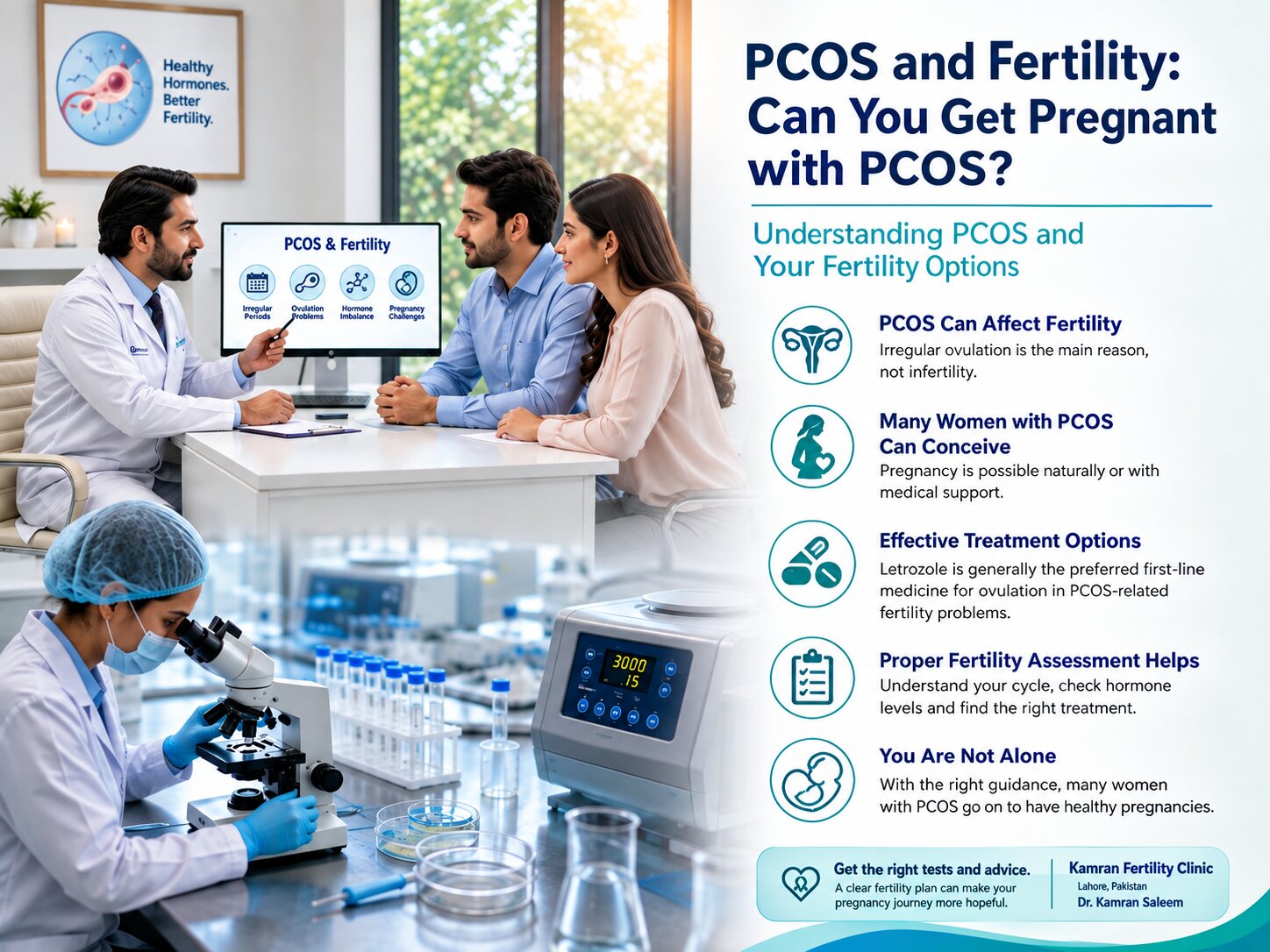
PCOS and Fertility: Can You Get Pregnant with PCOS?
A PCOS diagnosis often arrives with one question underneath it: will this stop me from having children? It’s one of the most common reasons women come to see a fertility specialist, and one of the most common sources of quiet worry between appointments. The short version is reassuring, but it deserves a proper explanation — not just a yes.
Quick answer: PCOS (polycystic ovary syndrome) is a hormonal condition that can make ovulation irregular or infrequent, which makes conceiving take longer. It is not the same as infertility. Most women with PCOS go on to get pregnant, either naturally with some support, with ovulation medication, or with fertility treatment when needed.
In this article: what causes PCOS, does PCOS cause infertility, how polycystic ovaries and fertility are connected, does PCOS affect egg quality, can you get pregnant with PCOS naturally, can PCOS cause miscarriage, PCOS treatment options, common myths vs facts, and FAQs.
What causes PCOS?
PCOS is caused by a hormonal imbalance, most often involving higher-than-typical levels of androgens (hormones present in everyone, but usually in smaller amounts in women) and, in many cases, insulin resistance — where the body doesn’t respond to insulin as efficiently as it should.
The exact cause isn’t fully understood, and it likely involves a combination of genetic and hormonal factors rather than one single trigger. What’s clear is that PCOS isn’t caused by anything a woman did — it’s not linked to diet choices or lifestyle in its origin, even though lifestyle can play a role in managing it afterward.
Does PCOS cause infertility?
PCOS doesn’t cause infertility in the way many people assume. It’s one of the most common causes of ovulation-related difficulty conceiving, but that’s different from being unable to conceive at all.
Ovulation is the release of an egg each cycle. In PCOS, hormonal imbalance can disrupt this process, so ovulation happens less often, less predictably, or sometimes not at all in a given cycle — a pattern called anovulation. Fewer ovulation windows means fewer chances to conceive naturally in any given month, which is why it can take longer, not why it becomes impossible.
Polycystic ovaries and fertility — how are they connected?
The name “polycystic ovaries” is a bit misleading. What shows up on an ultrasound isn’t a cluster of true cysts — it’s a higher number of small, immature follicles that haven’t developed and released an egg that cycle.
This follicle pattern is one of the signs doctors look for, alongside blood tests and your cycle history, when assessing PCOS. On its own, seeing this pattern on a scan doesn’t confirm PCOS or predict how it will affect your fertility — it’s one piece of a larger picture, not the full diagnosis.
Does PCOS affect egg quality?
Egg quality in PCOS is generally not the primary concern — the bigger issue is usually how often an egg is released, not the quality of the eggs themselves. Most women with PCOS have a normal egg reserve, and in some cases a higher one, since fewer eggs are used up through irregular ovulation over time.
That said, factors like age, insulin resistance, and other individual health factors can influence egg quality regardless of PCOS. This is one of the reasons a proper hormone and ultrasound assessment matters more than assumptions based on the diagnosis alone.
Can you get pregnant with PCOS naturally?
Yes, many women with PCOS conceive naturally, without fertility treatment. Because ovulation is less predictable, it can help to understand your own cycle better — tracking ovulation signs, for example — and to address any related factors like insulin resistance with your doctor.
There’s no guaranteed way to get pregnant with PCOS “quickly,” and it’s worth being cautious of anything that promises otherwise. What genuinely helps is a clear picture of whether and when you’re ovulating, so you’re not left guessing.
If natural conception hasn’t happened after several months of trying, especially alongside irregular cycles, that’s a reasonable point to speak with a specialist rather than continuing to wait it out alone.
Can PCOS cause miscarriage?
PCOS is associated with a somewhat higher risk of early miscarriage compared to women without PCOS, though most pregnancies in women with PCOS do proceed without this complication. The exact reasons aren’t fully settled, but insulin resistance and hormonal imbalance are thought to play a role for some women.
This isn’t something to self-diagnose or worry over in isolation — if you have PCOS and are pregnant or trying to conceive, your care team can monitor for and discuss this risk directly with you, based on your specific history.
PCOS treatment options
Treatment for PCOS-related fertility difficulty usually starts with the least invasive option likely to help, and moves forward step by step if needed, rather than jumping straight to advanced treatment.
- Lifestyle and metabolic support. Where insulin resistance is a factor, changes to diet and activity can help restore more regular ovulation for some women. This isn’t about reaching a specific weight — it’s about supporting hormonal balance.
- Ovulation induction medication. Letrozole or clomiphene are commonly used first-line options to encourage more regular ovulation. These require a doctor’s prescription and monitoring — not something to start independently.
- IUI (intrauterine insemination). If ovulation medication alone doesn’t lead to pregnancy after a reasonable number of cycles, combining it with IUI is sometimes the next step.
- IVF or ICSI. For women who don’t conceive with the steps above, or where other fertility factors are also present, IVF — or ICSI, when male-factor issues are involved — can be an appropriate option.
Can PCOS be cured? PCOS is a long-term hormonal condition rather than something that’s cured outright. But its impact on fertility can often be managed effectively — many women go on to conceive and have healthy pregnancies with the right support.
Common myths vs facts
| Myth | Fact |
|---|---|
| PCOS means you can’t get pregnant | Most women with PCOS can and do conceive, often without IVF |
| PCOS always causes miscarriage | Most PCOS pregnancies proceed without this complication; risk is somewhat higher, not typical |
| You need to lose a set amount of weight before treatment can start | Lifestyle support can help some women, but treatment isn’t withheld based on weight alone |
| PCOS is rare | It’s one of the most common hormonal conditions in women of reproductive age |
| There’s a quick fix to get pregnant with PCOS | No treatment guarantees speed — the real goal is restoring predictable ovulation |
| Irregular periods always mean PCOS | Irregular cycles have several possible causes; PCOS is one, not the only one |
When should you see a fertility specialist about PCOS?
If your periods are irregular, infrequent, or absent, or you’ve been trying to conceive for six months to a year without success, it’s a reasonable time to get assessed. You don’t need a confirmed PCOS diagnosis first — uncertainty about your symptoms is itself a good reason to get checked. For a broader look at timing, see when to seek fertility advice.
A proper assessment looks at ovulation, hormone levels, and your overall reproductive health together, rather than treating PCOS as an isolated issue. You can read more in our guide to fertility assessment in Lahore.
At Kamran Fertility Clinic in Lahore, Dr. Kamran Saleem assesses PCOS as part of a full fertility evaluation — reviewing your cycle history, hormone results, and ultrasound findings together before recommending next steps. You can learn more on the Fertility Assessment & Diagnosis page.
This article is general information, not a diagnosis. PCOS presents differently for every woman, and the right next step depends on your own history and test results — that’s what a consultation is for.
FAQs
Does PCOS cause infertility? Not in most cases. PCOS commonly causes irregular ovulation, which can make conceiving take longer, but the majority of women with PCOS are able to get pregnant.
Can you get pregnant with PCOS naturally? Yes. Many women with PCOS conceive without fertility treatment, particularly once ovulation becomes more regular through lifestyle support or medical guidance.
How can I get pregnant with PCOS quickly? There’s no guaranteed fast method, and it’s worth being wary of anything claiming otherwise. The most effective approach is understanding your ovulation pattern and addressing it with a specialist, rather than guessing.
Does PCOS affect egg quality? Not usually as the main issue — the bigger factor is typically how often ovulation happens, not the quality of the eggs. Age and other individual health factors matter more for egg quality than PCOS itself in most cases.
Can PCOS cause miscarriage? PCOS is linked with a somewhat higher risk of early miscarriage for some women, though most PCOS pregnancies continue without this complication. Your care team can discuss your individual risk factors with you.
Can PCOS be cured? PCOS is a long-term condition rather than a curable one, but its effect on fertility can often be managed well, and many women with PCOS go on to have children.
Do all women with PCOS need IVF? No. Many women respond to ovulation-inducing medication or lifestyle changes before IVF is ever considered. IVF is generally a later step, not a first one.
Is having polycystic ovaries the same as having PCOS? Not necessarily. The follicle pattern seen on an ultrasound is one diagnostic sign among several — it doesn’t confirm PCOS on its own without other criteria being met too.