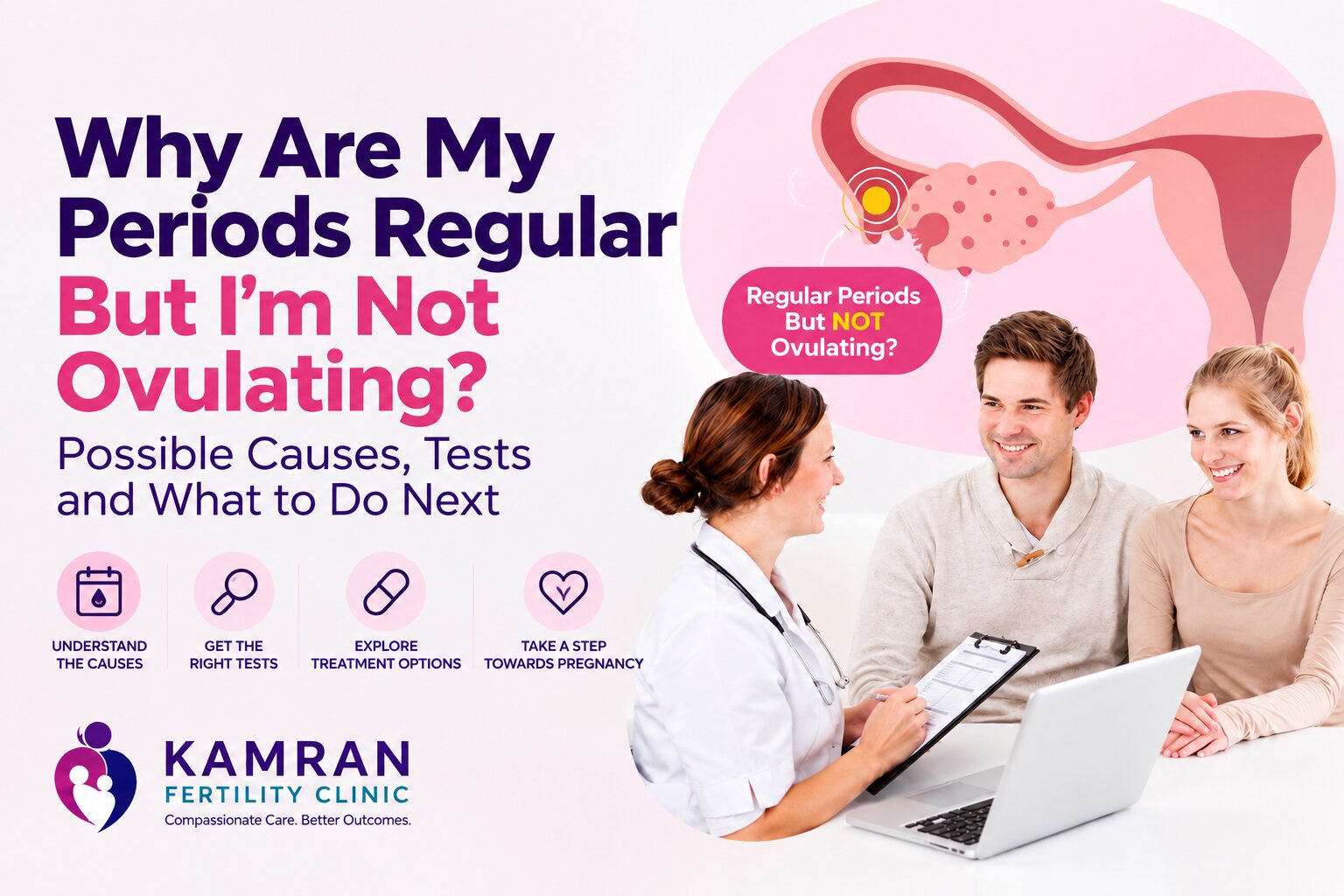
Why Is My Period Regular but I’m Not Getting Pregnant?
Having regular periods is generally a reassuring sign, but it does not guarantee that pregnancy will happen easily.
Conception requires several steps to work together. An egg needs to mature and be released, sperm must reach and fertilise the egg, at least one fallopian tube needs to be open and functioning, and the resulting embryo must successfully implant in the uterus.
This means you can have predictable menstrual cycles and still experience difficulty getting pregnant.
Possible reasons include male-factor infertility, blocked or damaged fallopian tubes, endometriosis, uterine conditions, age-related changes in fertility, problems with ovulation, PCOS, certain hormonal conditions, or unexplained infertility.
The important point is that regular periods are only one part of the fertility picture. If you have been trying to conceive without success, both partners may need to be assessed.
Can You Have Regular Periods and Still Not Get Pregnant?
Yes. Regular periods often suggest that ovulation is occurring, particularly when cycles are predictable, but they do not confirm that every part of the reproductive process is normal.
You may still have difficulty conceiving because of:
- Problems with sperm count, movement or morphology
- Blocked or damaged fallopian tubes
- Endometriosis
- Fibroids, polyps or other uterine conditions
- Age-related changes in egg quantity or quality
- Ovulation problems, including some cases of PCOS
- Thyroid or prolactin abnormalities
- Timing of intercourse
- Unexplained infertility
- A combination of factors affecting both partners
If you are under 35 and have been having regular, unprotected intercourse for 12 months without pregnancy, a fertility evaluation is generally recommended. If you are 35 or older, evaluation is generally recommended after 6 months. Earlier assessment may be appropriate when there are known risk factors or you are over 40.
What Do Regular Periods Tell You About Fertility?
Your menstrual cycle provides useful information, but it does not give a complete picture of fertility.
For many women, predictable cycles occurring approximately every 21–35 days are consistent with regular ovulation. However, pregnancy requires more than ovulation.
Think of conception as a chain:
- An egg needs to mature.
- The egg needs to be released from the ovary.
- Sperm need to reach the reproductive tract.
- Sperm and egg need to meet, usually in a fallopian tube.
- Fertilisation needs to occur.
- The resulting embryo needs to travel to the uterus.
- The embryo needs to implant successfully.
A regular period mainly tells you that the menstrual cycle is occurring. It does not by itself confirm that ovulation happens during every cycle, that the eggs are capable of successful fertilisation, that the fallopian tubes are open, that the sperm are healthy, that the uterus is structurally normal, or that implantation will occur.
A useful way to remember this: regular periods do not equal proven ovulation, and proven ovulation does not equal guaranteed fertility.
Can You Have Regular Periods but Not Ovulate?
Yes, although regular cycles generally make ovulatory dysfunction less likely.
Occasional anovulatory cycles can occur even in women who have apparently regular periods. Some women may also have relatively subtle ovulation problems without obvious changes in their cycle pattern.
Can PCOS Cause Fertility Problems With Regular Periods?
PCOS is commonly associated with irregular or absent periods, but not every person with PCOS has dramatically irregular cycles.
In some cases, ovulation may be less predictable or may not occur consistently despite apparently regular bleeding. This is why menstrual regularity alone should not be used to completely rule out an ovulation-related problem.
However, not every woman with regular periods needs extensive ovulation testing. Your doctor may decide whether testing is appropriate based on your cycle history, symptoms, examination and other fertility findings.
How Can Ovulation Be Checked?
When there is a reason to assess ovulation, several approaches may be considered.
- Menstrual history — the pattern and predictability of your cycles can provide useful information about whether ovulation is likely.
- Ovulation predictor kits — urine kits detect the luteinizing hormone (LH) surge that usually occurs shortly before ovulation. They can help identify the fertile period, although an LH surge does not always prove that ovulation actually occurred.
- Mid-luteal progesterone — a blood progesterone test can sometimes be used to provide evidence that ovulation has occurred. The timing of the test matters because progesterone levels change during the menstrual cycle.
- Ultrasound or follicular monitoring — in selected cases, ultrasound can be used to monitor follicle development and provide information about ovulation. This may be particularly useful when a fertility specialist needs more detailed information or when fertility treatment is being planned.
No single method is perfect for every person. The appropriate approach depends on your cycle, symptoms and clinical situation.
Why Am I Not Getting Pregnant if My Periods Are Regular?
There are several possible explanations. Importantly, more than one factor can sometimes be involved.
1. Male-Factor Infertility
Fertility is not only a female issue.
Sperm-related factors can make conception difficult even when the woman’s periods are completely regular.
A semen analysis can assess characteristics such as sperm concentration or count, sperm motility (movement), sperm morphology (shape), and semen volume and other relevant characteristics.
This is why evaluating only the woman can delay identification of the actual cause. When a couple is undergoing infertility evaluation, both partners should generally be assessed concurrently.
You can also learn more about male fertility testing and what a semen analysis means before your consultation.
2. Blocked or Damaged Fallopian Tubes
The fallopian tubes play an important role in natural conception.
After ovulation, the egg enters a fallopian tube, where fertilisation can occur if sperm are present. The early embryo then normally travels through the tube toward the uterus.
If a tube is blocked or damaged, this process can be disrupted.
Tubal problems may occur after previous pelvic infections, certain sexually transmitted infections, pelvic or reproductive surgery, endometriosis, or other conditions affecting the pelvis. Some women with tubal problems have no obvious symptoms.
How are blocked tubes tested? A test called hysterosalpingography (HSG) may be used to evaluate the uterine cavity and whether the fallopian tubes are open. Other approaches to assessing tubal patency may also be considered depending on the individual situation.
Having regular periods does not tell you whether your fallopian tubes are open.
3. Endometriosis
Endometriosis occurs when tissue similar to the lining of the uterus grows outside the uterus.
It can affect fertility through inflammation, changes around the ovaries and fallopian tubes, and pelvic adhesions.
Possible symptoms include severe or worsening period pain, pain during intercourse, chronic pelvic pain, pain associated with bowel movements or urination during periods, and difficulty becoming pregnant.
However, symptoms vary considerably. Some women with endometriosis may have relatively few symptoms. Regular menstrual cycles do not rule out endometriosis.
4. Uterine Problems
The uterus becomes important after fertilisation because the embryo needs to implant there and continue developing.
Certain uterine conditions can sometimes interfere with implantation or pregnancy, including uterine fibroids, endometrial polyps, certain uterine structural abnormalities, scar tissue inside the uterus, and other abnormalities affecting the uterine cavity.
A pelvic or transvaginal ultrasound may identify some structural problems. Additional testing may be recommended when the medical history or initial assessment suggests it is necessary.
5. Age-Related Changes in Fertility
Regular periods do not prevent fertility from changing with age.
Female fertility is influenced by both the number and quality of available eggs, and these factors generally change with increasing age. Age is therefore an important part of fertility assessment even when menstrual cycles remain regular.
This is also why recommendations about when to seek an infertility evaluation differ by age. If you are 35 or older, evaluation is generally recommended after six months of trying rather than waiting a full year. If you are over 40, speaking with a fertility specialist sooner may be appropriate.
6. Ovarian Reserve May Be Lower Than Expected
Ovarian reserve refers broadly to the remaining supply of eggs in the ovaries.
Tests such as AMH, antral follicle count, and certain hormone measurements may provide information about ovarian reserve in selected situations.
However, ovarian reserve testing should not be interpreted as a simple fertility score. For example, an AMH result alone cannot tell you whether you will or will not become pregnant naturally. Results need to be considered alongside age, medical history, menstrual history and other fertility findings.
7. Thyroid or Prolactin Problems
Hormonal conditions can sometimes affect fertility even when menstrual cycles appear relatively regular.
The thyroid gland plays an important role in reproductive health, and thyroid disorders can affect ovulation and pregnancy.
Similarly, elevated prolactin levels can interfere with reproductive function. High prolactin is more commonly associated with irregular or absent periods, but symptoms and cycle patterns can vary.
Hormone testing is therefore not automatically necessary for every woman with infertility. Your doctor may recommend specific hormone tests when your symptoms, history or examination suggest they could provide useful information.
8. Timing of Intercourse May Be Reducing Your Chances
Sometimes the issue is not an underlying fertility disorder but simply that intercourse is not occurring frequently enough during the fertile window.
Pregnancy is most likely when intercourse occurs during the days leading up to ovulation and around ovulation. Because the exact day of ovulation can vary between cycles, relying on one predicted day can make timing less effective.
For couples trying naturally, having intercourse regularly throughout the fertile period can help ensure that sperm are present when ovulation occurs. Ovulation predictor kits may also help some couples identify the fertile window.
If you have been timing intercourse appropriately and still have not conceived after the recommended period, a fertility evaluation can help determine whether another factor is involved.
9. Lifestyle and Environmental Factors
Lifestyle factors can also influence reproductive health in both men and women.
Relevant factors may include smoking, excessive alcohol consumption, significant underweight or overweight, poor nutrition, some recreational drug use, certain medications or occupational exposures, and very high levels of physical stress or demanding exercise in some individuals.
These factors do not explain every case of infertility, and infertility should not automatically be blamed on lifestyle. However, reviewing modifiable factors can be a useful part of preconception and fertility care.
Both partners should consider their lifestyle because sperm production and reproductive health can also be affected by health and environmental factors.
10. Unexplained Infertility
Sometimes a fertility evaluation does not identify an obvious reason for difficulty conceiving. This is known as unexplained infertility.
It does not mean that the problem is imaginary or that pregnancy is impossible. Rather, it means that standard evaluation has not identified a clear explanation.
Management may depend on factors such as age, how long you have been trying, previous pregnancies, semen-analysis findings, tubal status, ovarian findings, previous fertility treatment, and individual preferences. The appropriate next step should therefore be based on the complete clinical picture rather than a single test.
Does Regular Menstruation Mean My Eggs Are Healthy?
No.
Regular menstruation does not provide a complete assessment of egg quality.
Egg quantity and egg quality are different concepts. Ovarian reserve tests can provide information about the number of remaining eggs, but they do not directly measure the quality of every egg.
There is also no single routine test that can completely predict whether someone will become pregnant naturally. Age remains one of the most important factors when interpreting fertility information.
Could My Partner Be the Reason We Are Not Getting Pregnant?
Yes.
Male factors can contribute to difficulty conceiving either on their own or together with female factors.
For this reason, it is generally not appropriate to assume that the woman is the cause simply because she is the person experiencing regular menstrual cycles.
A semen analysis is one of the basic investigations used to assess male fertility. If the result is abnormal, the doctor may recommend repeat testing or further evaluation depending on the findings.
What Fertility Tests Are Needed if Periods Are Regular?
There is no single fertility test that is appropriate for everyone.
A fertility evaluation is usually tailored according to age, duration of trying to conceive, menstrual and reproductive history, previous pregnancies, medical and surgical history, symptoms, previous fertility investigations, and the male partner’s reproductive history.
Depending on the situation, evaluation may include:
| Area | What May Be Assessed |
|---|---|
| Ovulation | Menstrual history and, when indicated, ovulation assessment |
| Ovaries | Ultrasound and selected ovarian-reserve tests |
| Uterus | Pelvic/transvaginal ultrasound and additional tests when indicated |
| Fallopian tubes | HSG or another appropriate tubal-patency assessment |
| Male fertility | Semen analysis and reproductive history |
| Hormones | Selected hormone tests based on symptoms and clinical history |
| Medical history | Previous infections, surgery, medications, pregnancies and relevant health conditions |
The goal is not to order every possible fertility test. A structured evaluation focuses on the factors most relevant to the individual couple.
If you are looking for a structured evaluation, you can also learn more about fertility assessment and diagnosis and what a fertility consultation may involve.
Do I Need an HSG if I Have Regular Periods?
Not necessarily.
However, regular periods do not rule out blocked or damaged fallopian tubes.
An HSG is an imaging procedure that can be used to assess the uterine cavity and whether the fallopian tubes are open.
Your doctor may recommend tubal assessment based on factors such as how long you have been trying to conceive, previous pelvic infection, previous pelvic or reproductive surgery, suspected or known endometriosis, previous ectopic pregnancy, or other reproductive history.
The decision should be individualized rather than based solely on whether your periods are regular.
When Should You See a Fertility Specialist if Your Periods Are Regular?
The recommended timing depends mainly on age and medical history.
If You Are Under 35
If you have regular, unprotected intercourse and have not conceived after 12 months, a fertility evaluation is generally recommended.
If You Are 35 or Older
An evaluation is generally recommended after 6 months of trying.
If You Are Over 40
Earlier evaluation is generally appropriate rather than waiting six or twelve months.
You may need an evaluation sooner if you have:
- A history of pelvic infection
- Previous pelvic or reproductive surgery
- Suspected or known endometriosis
- Severe period pain
- A known reproductive condition
- Previous fertility problems
- Recurrent pregnancy loss
- A partner with a known or suspected sperm problem
- Another medical or reproductive factor that may affect fertility
Having regular periods should not delay assessment when there is a known reason for concern.
What Should a Couple Expect During a Fertility Consultation?
A fertility consultation usually begins with a detailed history rather than immediately ordering every available test.
The doctor may ask about how long you have been trying to conceive, menstrual-cycle pattern, frequency and timing of intercourse, previous pregnancies or miscarriages, previous contraception, pelvic infections, previous surgeries, period pain or pain during intercourse, previous fertility tests, previous fertility treatment, medications, relevant medical conditions, and your partner’s reproductive and medical history.
The doctor can then determine which investigations are most appropriate.
At Kamran Fertility Clinic in Lahore, Dr. Kamran Saleem, MBBS, Dip GUM & Ven (UK), provides fertility consultations and assessment for couples seeking to understand possible factors affecting conception.
The purpose of an assessment is not simply to label someone as “fertile” or “infertile.” It is to identify the information needed to understand the situation and discuss appropriate next steps.
What Happens if All Fertility Tests Are Normal?
If standard fertility investigations do not identify an obvious cause, the situation may be described as unexplained infertility.
This does not mean that pregnancy cannot happen. It means that commonly identifiable causes have not been found through the tests performed.
Your doctor may consider factors such as your age, duration of infertility, previous pregnancy history and test results when discussing what to do next.
Treatment options can vary considerably between couples, so there is no single treatment plan for everyone with unexplained infertility.
What Treatments Are Available if I Am Not Getting Pregnant?
Treatment depends on the cause, age, duration of infertility and findings from the fertility assessment.
Depending on the situation, management may include:
- Correcting an identified hormonal or medical problem
- Optimising timing of intercourse
- Treatment for ovulation problems when appropriate
- Treatment or management of endometriosis
- Addressing certain tubal or uterine problems
- Treatment for male-factor infertility
- Fertility medications
- Intrauterine insemination (IUI)
- In vitro fertilisation (IVF)
- Intracytoplasmic sperm injection (ICSI)
Not everyone needs fertility treatment, and not everyone needs IVF.
The purpose of fertility testing is to understand the likely cause and choose an approach that makes sense for the individual couple. You can explore the full fertility treatment options in Lahore to understand how different treatments may fit different situations.
Regular Periods but Not Pregnant: What Should You Do Next?
If you have been trying to conceive without success, do not assume that your regular periods mean everything has already been checked.
A sensible fertility evaluation may consider both partners and multiple stages of conception:
- Review your menstrual and reproductive history.
- Consider whether ovulation is likely and whether further assessment is needed.
- Assess the male partner, including semen analysis when appropriate.
- Evaluate the uterus and ovaries.
- Assess the fallopian tubes when clinically indicated.
- Consider endometriosis and other pelvic conditions based on symptoms and history.
- Review relevant hormonal or medical factors.
- Consider age, duration of infertility and previous pregnancy history.
- Discuss the findings before deciding on treatment.
This approach helps avoid focusing on only one possible explanation.
Common Myths About Regular Periods and Pregnancy
| Myth | Fact |
|---|---|
| Regular periods mean I am definitely fertile. | Regular cycles are reassuring but do not rule out male, tubal, uterine, ovarian or other fertility factors. |
| If I have regular periods, I cannot have infertility. | Infertility can occur despite regular menstrual cycles. |
| Regular periods prove that I ovulate every month. | Regular cycles usually suggest ovulation, but they do not provide absolute proof that ovulation occurs in every cycle. |
| Fertility problems are usually caused by the woman. | Either partner, or both partners together, can contribute to difficulty conceiving. |
| AMH tells me whether I can get pregnant. | AMH provides information about ovarian reserve but is not a complete test of natural fertility. |
| I do not need an HSG because my periods are regular. | Menstrual regularity does not show whether the fallopian tubes are open. |
| I should wait a full year regardless of my age. | Evaluation is generally recommended after 12 months under age 35 and after 6 months at age 35 or older, with earlier assessment in some situations. |
| If every test is normal, there is no treatment option. | Some couples have unexplained infertility, and management can still be discussed based on their individual circumstances. |
Frequently Asked Questions
Can I Have Regular Periods and Still Be Infertile?
Yes. Regular periods often suggest that ovulation is occurring, but fertility also depends on sperm, fallopian tubes, the uterus, ovarian factors, age and other reproductive processes.
Why Am I Not Getting Pregnant Even Though I Ovulate?
Ovulation is only one step in conception. Problems involving sperm, fallopian tubes, endometriosis, the uterus, egg-related factors, age or other causes can still make pregnancy difficult.
Should My Husband Get a Fertility Test if My Periods Are Normal?
Yes. When a couple is being evaluated for infertility, both partners should generally be assessed. A semen analysis is one of the basic investigations used to assess male fertility.
Can Blocked Fallopian Tubes Cause Infertility With Regular Periods?
Yes. A woman can have completely regular periods while one or both fallopian tubes are blocked or damaged. Tubal patency can be assessed with an HSG or another appropriate test when indicated.
Can Endometriosis Cause Infertility if Periods Are Regular?
Yes. Endometriosis can affect fertility even when menstrual cycles are regular. Severe period pain, painful intercourse or chronic pelvic pain can provide clues, although some women have few symptoms.
Can PCOS Cause Infertility if My Periods Are Regular?
It can. PCOS is commonly associated with irregular cycles, but some people with PCOS may have apparently regular bleeding while ovulation is not consistently occurring. A doctor can determine whether further ovulation assessment is appropriate. Read more about PCOS and fertility.
Can Thyroid Problems Affect Fertility Even if My Periods Are Regular?
Thyroid disorders can affect reproductive function. However, thyroid testing is not automatically required for every person experiencing infertility and is usually considered based on symptoms, history and clinical findings.
How Long Should I Try to Get Pregnant Before Seeing a Doctor?
If you are under 35, a fertility evaluation is generally recommended after 12 months of trying. If you are 35 or older, evaluation is generally recommended after 6 months. Women over 40 may benefit from earlier assessment.
What Is the First Fertility Test for a Woman With Regular Periods?
There is no single first test for everyone. Evaluation usually begins with a medical and reproductive history, followed by targeted testing based on age, symptoms, duration of infertility and other findings.
Does AMH Tell Me Whether I Can Get Pregnant Naturally?
No. AMH can provide information about ovarian reserve, but it is not a complete measure of fertility and cannot by itself predict whether natural pregnancy will occur.
Do I Need an HSG if I Have Regular Periods?
Not necessarily. HSG is considered when assessment of the fallopian tubes and uterine cavity is appropriate. Regular periods alone cannot confirm that the tubes are open.
Can Stress Alone Cause Infertility?
Stress and emotional wellbeing can affect overall health and may influence reproductive behaviours or, in some circumstances, reproductive function. However, infertility should not simply be attributed to stress without appropriate evaluation.
Can Infertility Be Unexplained Even When All Tests Are Normal?
Yes. Unexplained infertility is diagnosed when standard evaluation does not identify a clear cause. It does not mean pregnancy is impossible or that treatment cannot be considered.
Regular Periods but Not Pregnant?
Regular periods are a good sign, but they are not a complete fertility assessment.
You can have predictable menstrual cycles and still experience difficulty getting pregnant because of sperm-related factors, blocked fallopian tubes, endometriosis, uterine conditions, age-related fertility changes, ovulation problems, hormonal factors or unexplained infertility.
If you have been trying to conceive for the recommended period, the most useful next step is usually a structured fertility evaluation of both partners rather than repeatedly checking whether your periods remain regular. Understanding the cause, when possible, can help you and your doctor decide what to do next.
For couples in Lahore, Kamran Fertility Clinic offers fertility consultations and assessment to help you discuss your history, possible causes and appropriate investigations with Dr. Kamran Saleem.
Medical note: This article is intended for general educational purposes and does not provide a diagnosis or replace an individual consultation with a qualified healthcare professional.
If you have been trying to conceive and want to understand what may be affecting your chances, Kamran Fertility Clinic provides fertility consultation and assessment in Lahore. A consultation can help review your history and determine which investigations, if any, may be appropriate before discussing treatment.