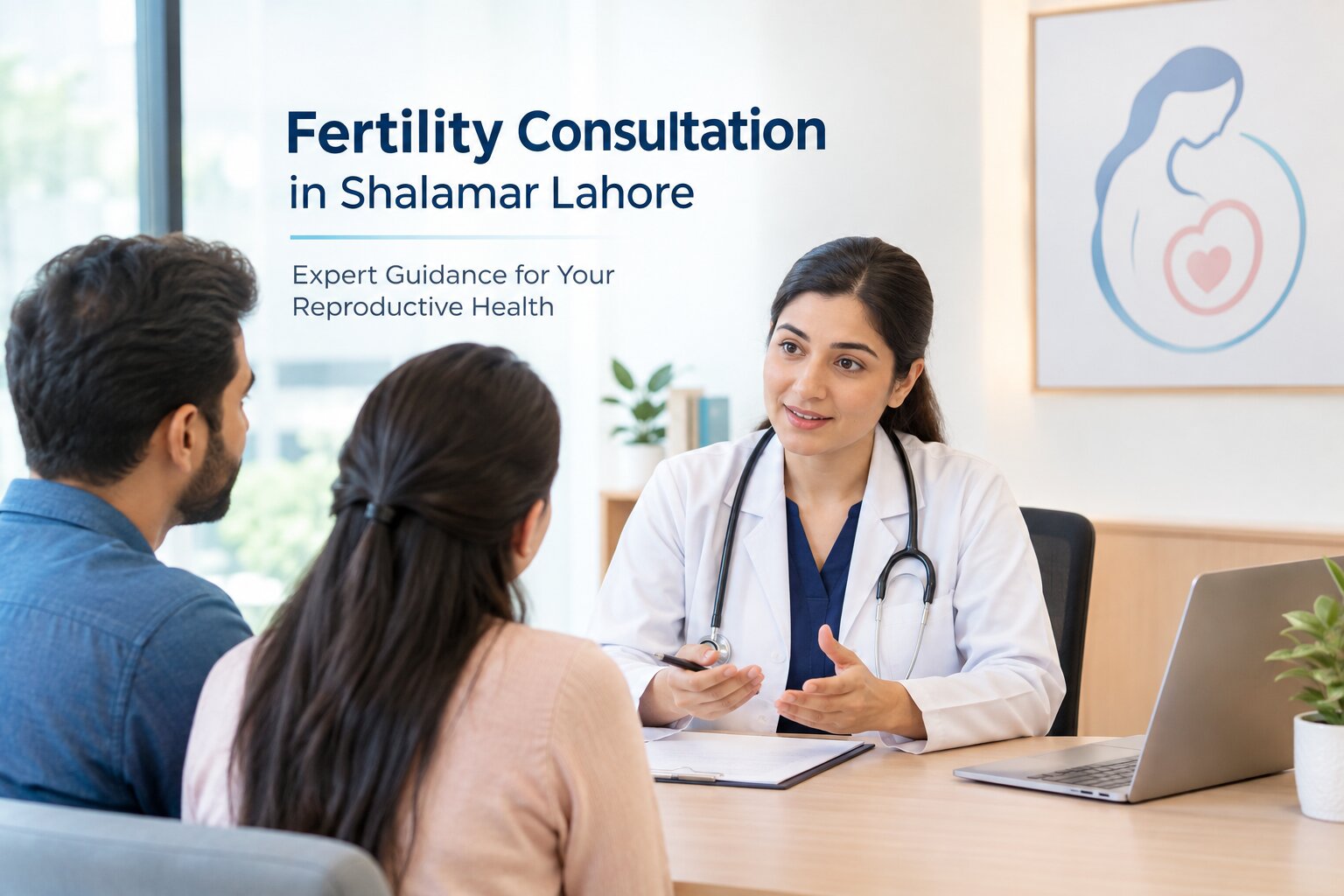
Fertility Consultation in Shalamar Lahore: Complete Guide to Fertility Testing, Causes and Treatment
If you have been trying to conceive without success, you may be wondering whether you need fertility testing, which partner should be evaluated, or whether treatment is necessary. A fertility consultation in Shalamar Lahore is designed to answer those questions systematically. It can help identify potentially treatable causes while avoiding unnecessary tests or treatments.
What Is a Fertility Consultation in Shalamar Lahore?
A fertility consultation in Shalamar Lahore is a medical appointment in which a fertility specialist reviews your reproductive history, examines relevant risk factors, and determines whether fertility testing or treatment is appropriate. Evaluation may include assessment of ovulation, the uterus and fallopian tubes, ovarian function, and sperm health. Both partners are generally evaluated when applicable.
The first consultation does not automatically mean that you need IVF or another assisted reproductive treatment. Depending on your age, medical history, duration of trying to conceive, and initial findings, the appropriate next step may be reassurance and continued attempts at natural conception, targeted testing, treatment of an underlying condition, or referral for fertility treatment.
For people searching for an infertility clinic in Shalamar Lahore, it is important to distinguish a fertility consultation from a treatment procedure. The consultation is primarily about understanding the clinical situation and deciding what should happen next.
When Should You Have a Fertility Consultation?
The appropriate timing depends on age and individual risk factors.
For women younger than 35, an infertility evaluation is generally recommended after 12 months of regular, unprotected intercourse without pregnancy, when there are no earlier indications for evaluation.
For women aged 35 or older, evaluation is generally recommended after 6 months without conception. For women older than 40, more immediate evaluation may be appropriate.
You should not necessarily wait 6 or 12 months if there is already a reason to suspect impaired fertility.
You may need evaluation sooner if you have:
- Irregular or absent menstrual periods
- Very short or highly irregular cycles
- Suspected ovulation problems
- Known or suspected endometriosis
- Previous pelvic inflammatory disease
- Previous ectopic pregnancy
- Known or suspected fallopian-tube disease
- Previous pelvic or reproductive surgery
- Recurrent pregnancy loss
- Previous chemotherapy or radiation
- Known diminished ovarian reserve
- Previous abnormal semen analysis
- Testicular injury or surgery
- Erectile or ejaculation problems
- Known reproductive disorders in either partner
ASRM recommends beginning evaluation without delay when a medical history or finding is already associated with infertility. If you’re unsure whether your situation qualifies, our guide on when to seek fertility consultation covers this in more detail.
Why Can Fertility Problems Affect Either Partner?
Infertility is not exclusively a woman’s problem.
Pregnancy requires several biological steps to occur successfully:
- An egg must mature and be released from the ovary.
- Sperm must be produced in adequate numbers and function normally.
- Sperm must reach and fertilize the egg.
- The resulting embryo must travel through the fallopian tube.
- The embryo must implant in the uterus.
- The pregnancy must continue normally.
Problems can occur at any of these stages.
WHO recognizes male factors, female factors, combined factors, and unexplained infertility as possible categories. Female causes can involve the ovaries, fallopian tubes, uterus, or endocrine system, while male causes can involve sperm production, sperm movement, sperm morphology, hormonal regulation, or obstruction of the reproductive tract.
This is why evaluating only the woman may miss an important contributor to delayed conception.
What Causes Infertility?
There is no single cause of infertility. A fertility consultation aims to determine which possibilities are relevant to the individual rather than assuming that one diagnosis applies to everyone.
Ovulation disorders
Ovulation is the release of an egg from an ovary.
If ovulation does not occur regularly, the opportunity for fertilization can be reduced.
Possible causes include:
- Polycystic ovary syndrome (PCOS)
- Disorders of the thyroid
- Elevated prolactin in selected circumstances
- Hypothalamic or pituitary disorders
- Very low body weight
- Significant weight changes
- Excessive exercise
- Some medications
- Other endocrine disorders
Irregular or absent periods can provide an important clue.
However, menstrual symptoms alone do not establish a diagnosis. A clinician considers the complete reproductive and medical history.
Fallopian-tube problems
The fallopian tubes connect the ovaries and uterus and provide the usual location where sperm and egg meet.
Blocked or damaged tubes can interfere with fertilization or embryo transport.
Tubal disease may be associated with:
- Previous pelvic infection
- Sexually transmitted infections
- Previous ectopic pregnancy
- Pelvic or abdominal surgery
- Endometriosis
- Other pelvic disease
An important clinical point is that tubal blockage may occur without obvious symptoms.
A person can have regular periods and a normal pelvic ultrasound while still having tubal-factor infertility.
Uterine conditions
The uterus provides the environment in which an embryo implants and pregnancy develops.
Some uterine conditions can affect fertility, including:
- Fibroids
- Endometrial polyps
- Intrauterine adhesions
- Congenital uterine abnormalities
- Certain inflammatory conditions
However, finding an abnormality does not automatically mean that it is responsible for infertility.
Its location, size, relationship to the uterine cavity, symptoms, and other fertility factors must be considered.
Endometriosis
Endometriosis occurs when tissue similar to the lining of the uterus grows outside the uterus.
It may be associated with:
- Pelvic pain
- Painful periods
- Pain during intercourse
- Infertility
However, the severity of pain does not necessarily indicate the severity of fertility impairment.
Further investigation depends on the patient’s symptoms and clinical history.
Male-factor infertility
Male fertility can be affected by abnormalities involving sperm production, sperm movement, sperm morphology, ejaculation, reproductive tract obstruction, or hormonal regulation.
Possible contributors include:
- Low sperm concentration
- Reduced sperm motility
- Abnormal sperm morphology
- Varicocele in selected cases
- Previous testicular injury
- Certain infections
- Hormonal disorders
- Obstruction of the reproductive tract
- Some medications
- Anabolic steroid use
- Previous chemotherapy or radiation
WHO notes that abnormal sperm production, sperm movement, sperm morphology, reproductive-tract obstruction, and hormonal disorders can contribute to male infertility.
Unexplained infertility
Sometimes the standard evaluation does not identify a clear cause.
This is called unexplained infertility.
It does not mean that the couple has no biological explanation. Rather, it means that the currently available routine evaluation has not identified a specific cause.
ESHRE describes unexplained infertility as a diagnosis of exclusion and emphasizes that evidence for some additional tests and treatments remains limited or uncertain.
What Happens During a Fertility Consultation?
A good fertility consultation should follow a structured clinical process rather than simply ordering every available fertility test.
1. Medical and reproductive history
The specialist may ask about:
- How long you have been trying to conceive
- Age of both partners
- Menstrual-cycle length and regularity
- Frequency of sexual intercourse
- Previous pregnancies
- Miscarriages or ectopic pregnancies
- Previous fertility treatment
- Pelvic pain
- Abnormal bleeding
- Previous pelvic infections
- Previous surgery
- Existing medical conditions
- Current medications and supplements
- Previous ultrasound or laboratory results
- Family history
- Relevant lifestyle factors
For a male partner, the history may also include previous testicular injury, surgery, infection, medication use, anabolic steroid exposure, sexual function, ejaculation, and previous semen-analysis results.
2. Physical examination
A physical examination is not identical for every patient.
Depending on the history, the clinician may assess:
- General health
- Body weight
- Signs of hormonal disorders
- Pelvic findings
- Reproductive anatomy
- Testicular or scrotal findings in men
The purpose is to identify findings that could change the investigation or treatment plan.
3. Initial investigations
Testing is selected according to the clinical history.
Possible investigations include:
- Semen analysis
- Pelvic ultrasound
- Ovulation assessment
- Selected hormone tests
- Ovarian-reserve assessment when appropriate
- Fallopian-tube testing
- Uterine-cavity assessment when indicated
- Additional investigations for specific medical conditions
ASRM recommends assessing ovulation, the structure and patency of the female reproductive tract, and the semen of the male partner as core elements of infertility evaluation.
Which Fertility Tests Might Be Needed?
Not every patient needs every fertility test.
The most useful test is the one that answers a specific clinical question and can potentially change management.
Semen analysis
A semen analysis evaluates characteristics of ejaculated semen and sperm.
Depending on the laboratory method, it may assess:
- Semen volume
- Sperm concentration
- Total sperm number
- Motility
- Progressive motility
- Morphology
- Vitality
A semen analysis is an important first-line investigation when a male partner is involved in conception.
One abnormal result does not necessarily establish permanent infertility because semen parameters can vary.
The updated 2026 NICE guideline recommends repeat confirmatory testing after an abnormal initial semen analysis, with timing influenced by the severity of the abnormality.
What a semen analysis cannot tell you
A semen analysis is important, but it is not a complete measure of male fertility.
A result outside a reference range does not automatically mean that pregnancy is impossible.
Conversely, a result within reference ranges does not guarantee pregnancy.
The result must be interpreted together with the couple’s reproductive history and the female partner’s fertility factors.
Does AMH Tell You Whether You Can Get Pregnant?
Anti-Müllerian hormone (AMH) is often discussed as a measure of ovarian reserve.
Ovarian reserve refers broadly to the remaining pool of eggs and the expected ovarian response to stimulation.
But ovarian reserve is not the same as natural fertility.
This distinction is extremely important.
The 2026 NICE fertility guideline recommends that AMH should not be used to predict clinical pregnancy through spontaneous conception. AMH or antral follicle count may instead help predict ovarian response during assisted conception and support treatment counselling.
Therefore:
- Low AMH does not by itself mean that natural pregnancy is impossible.
- Likewise, a reassuring AMH result does not guarantee that pregnancy will occur.
Age remains an important factor when assessing overall reproductive potential.
What Does an Ultrasound Show During Fertility Evaluation?
A pelvic ultrasound can provide information about:
- The uterus
- Endometrial lining
- Ovaries
- Follicles
- Fibroids
- Some ovarian cysts
- Some structural abnormalities
Ultrasound can be very useful, but it does not answer every fertility question.
For example, a routine ultrasound cannot reliably establish that both fallopian tubes are open.
This is why fertility assessment sometimes requires additional testing.
How Are Blocked Fallopian Tubes Tested?
When tubal-factor infertility is suspected, a clinician may recommend a test to assess tubal patency, meaning whether the fallopian tubes are open.
Depending on the clinical circumstances, options can include:
- Hysterosalpingography (HSG)
- Hysterosalpingo-contrast ultrasonography
- Laparoscopy with dye in selected situations
NICE recommends HSG for appropriate patients without known comorbidities such as pelvic inflammatory disease, previous ectopic pregnancy, or endometriosis, and identifies contrast-ultrasound techniques as an alternative where suitable expertise is available. Laparoscopy may be appropriate when additional pelvic disease is suspected.
The choice should therefore be individualized.
Are Hormone Tests Necessary for Everyone?
No.
A common misconception is that a fertility work-up requires a large panel of reproductive hormones.
Testing should be guided by the clinical question.
For example, women with regular monthly menstrual cycles are generally likely to be ovulating. NICE does not recommend routine prolactin testing unless there is an ovulatory disorder, galactorrhoea, or a pituitary-related indication. Thyroid testing is recommended when symptoms suggest thyroid disease.
This is an important distinction:
More testing does not automatically mean better fertility care. Tests should be chosen because their results are likely to provide clinically useful information.
What Treatments May Be Considered After Fertility Evaluation?
Treatment depends on the cause, age, duration of infertility, reproductive goals, and results for both partners.
There is no single fertility treatment that is appropriate for everyone.
Treating ovulation problems
If ovulation is irregular or absent, treatment may address the underlying cause and, when appropriate, use medication to induce ovulation.
The treatment depends on why ovulation is abnormal.
For example, management of PCOS-related anovulation is different from management of hypothalamic or pituitary causes.
Medication should therefore be prescribed and monitored according to the individual diagnosis.
Treating male-factor infertility
Management depends on the specific abnormality.
Possible approaches may include:
- Correcting an underlying medical problem
- Reviewing medications
- Addressing relevant lifestyle factors
- Hormonal treatment for selected endocrine disorders
- Surgical management in selected conditions
- Sperm retrieval in specific cases
- IUI or IVF/ICSI when clinically appropriate
An important misconception concerns testosterone.
Testosterone replacement is not a fertility treatment for men trying to conceive.
Exogenous testosterone can suppress the hormonal signals required for sperm production, so men seeking fertility should discuss testosterone use with a qualified clinician before starting or continuing treatment.
Intrauterine insemination (IUI)
Intrauterine insemination (IUI) involves placing prepared sperm directly into the uterus around the time of ovulation.
It may be considered in selected situations, depending on factors such as:
- Age
- Ovulation
- Tubal patency
- Semen parameters
- Duration and cause of infertility
- Previous treatment
IUI is not automatically appropriate for every fertility problem.
In vitro fertilization (IVF)
In vitro fertilization (IVF) involves ovarian stimulation, egg retrieval, fertilization in a laboratory, embryo development, and transfer of an embryo into the uterus.
IVF may be considered for several causes of infertility, including selected cases involving:
- Tubal disease
- Significant male-factor infertility
- Certain ovulatory or reproductive conditions
- Unexplained infertility after appropriate management
- Other circumstances in which simpler treatments are unsuitable or unsuccessful
The decision should take into account the entire clinical picture.
Intracytoplasmic sperm injection (ICSI)
Intracytoplasmic sperm injection (ICSI) is an IVF technique in which an individual sperm is injected directly into an egg.
It can be particularly relevant when significant male-factor infertility or previous fertilization problems are present.
ICSI is not simply a universally superior form of IVF. Its use should be based on the indication and clinical circumstances.
When Is It Reasonable to Keep Trying Naturally?
A fertility consultation does not always lead to treatment.
Expectant management may be reasonable when:
- The couple has been trying for a relatively short period
- The woman is younger and has no significant risk factors
- Menstrual cycles suggest regular ovulation
- There is no known major male factor
- There is no suspected tubal or uterine disease
- The clinician believes immediate treatment is unlikely to provide meaningful benefit
However, age and risk factors matter.
Female fertility declines with age, and ASRM identifies female age as the single most important predictor of fecundity.
This is why delaying evaluation for years without considering age and medical history may not be appropriate for everyone.
Which Fertility Treatments Are Established, and Which Require Caution?
Patients often encounter fertility tests and treatments online that are described as essential, revolutionary, or universally beneficial.
Evidence does not support treating all fertility interventions equally.
Established clinical approaches
Depending on the diagnosis, established fertility care can include:
- Ovulation treatment
- Management of underlying reproductive disorders
- IUI in selected patients
- IVF
- ICSI in appropriate circumstances
- Surgical management of selected structural or reproductive problems
- Fertility preservation for appropriate medical indications
Tests or add-ons requiring careful consideration
Some investigations and IVF add-ons have limited, conflicting, or condition-specific evidence.
For example, the 2026 NICE guideline recommends against routine sperm-DNA-fragmentation testing during fertility investigation and recommends against endometrial scratching as a pretreatment intended to improve IVF outcomes.
ESHRE similarly emphasizes that evidence for many additional tests and treatments in unexplained infertility remains limited or of very low quality.
This does not mean that every emerging approach is useless. It means that patients should understand the strength of evidence, potential benefit, cost, and uncertainty before proceeding.
Can Lifestyle Changes Improve Fertility?
Lifestyle factors can influence reproductive health, but lifestyle advice should not be presented as a cure for every fertility problem.
Factors associated with impaired fertility can include:
- Smoking
- Excessive alcohol consumption
- Obesity
- Very low body weight
- Excessive exercise in susceptible individuals
- Anabolic steroid use
- Certain environmental exposures
WHO recognizes associations between infertility and factors including smoking, excessive alcohol use, obesity, and environmental exposures.
A balanced approach may include:
- Maintaining a healthy weight
- Avoiding smoking
- Avoiding anabolic steroids
- Limiting excessive alcohol consumption
- Managing chronic medical conditions
- Reviewing potentially fertility-affecting medications with a clinician
- Maintaining appropriate physical activity
- Seeking medical assessment when indicated
Lifestyle measures can support reproductive health, but they should not delay appropriate fertility evaluation when significant risk factors are present.
What Should You Bring to a Fertility Consultation?
You can make your appointment more productive by bringing previous medical information.
Useful documents include:
- Previous semen-analysis reports
- Hormone results
- Ultrasound reports
- HSG or other tubal-test reports
- Previous IVF or IUI records
- Previous pregnancy or miscarriage records
- Operative reports
- Current medication list
- Relevant medical records
It can also help to know:
- The date your last menstrual period started
- Typical cycle length
- How long you have been trying to conceive
- How frequently intercourse occurs
- Previous pregnancy outcomes
- Any previous fertility diagnosis
If both partners can attend, this may make the initial assessment more comprehensive.
What Questions Should You Ask at an Infertility Clinic in Shalamar Lahore?
Rather than asking only, “Do I need IVF?”, consider asking:
- What are the most likely causes of our fertility problem?
- Should both partners be tested?
- Which tests do I actually need, and what will each test tell us?
- What can this test not tell us?
- If a result is abnormal, does it need to be repeated?
- Do we need treatment now, or is it reasonable to continue trying naturally?
- What treatment would address the underlying cause?
- What are the alternatives to the proposed treatment?
- What are the potential risks and side effects?
- Which recommendations are well established, and which have uncertain evidence?
These questions can help you understand the reasoning behind a treatment plan rather than simply receiving a list of procedures. If you already have reports from previous testing or treatment elsewhere, our second opinion service can help you make sense of them before deciding on next steps.
Where Can You Seek a Fertility Consultation in Shalamar Lahore?
For patients specifically searching for a fertility consultation in Shalamar Lahore, the local healthcare pathway should be verified directly with the clinic before visiting because consultation schedules and service arrangements can change.
Kamran Fertility Clinic lists its Shalamar-area consultation location at Shahnaz Hospital, Shalamar Link Road, Lahore. The clinic’s location information should be checked directly when arranging an appointment for current consultation timings and availability.
This location-specific information is separate from the general medical guidance in this article. The appropriate tests and treatments still depend on the individual patient’s medical history and clinical assessment.
When Should You Seek Urgent Medical Attention?
Infertility itself is generally not an emergency.
However, reproductive symptoms can sometimes indicate a condition requiring urgent assessment.
Seek urgent medical attention for symptoms such as:
- Severe or rapidly worsening pelvic or abdominal pain
- Heavy vaginal bleeding accompanied by weakness or fainting
- Severe abdominal pain with a positive pregnancy test
- Fainting or collapse
- Sudden severe testicular pain or swelling
- Severe shortness of breath or other serious symptoms following fertility treatment
A person who may be pregnant and develops significant pelvic pain, bleeding, dizziness, or fainting should receive prompt medical assessment because ectopic pregnancy is one possible cause.
These symptoms should not be managed by waiting for a routine fertility consultation.
What Happens After the Fertility Consultation?
The next step depends on the findings.
A fertility specialist may recommend:
Option 1: Continue trying naturally
This may be appropriate when there is no significant abnormality and immediate treatment is not indicated.
Option 2: Targeted investigation
Additional testing may be recommended when the initial assessment raises a specific clinical question.
Option 3: Treat an identified cause
For example, management may focus on an ovulation disorder, hormonal problem, structural abnormality, or selected male-factor condition.
Option 4: Assisted reproduction
IUI, IVF, ICSI, or another fertility treatment may be considered when clinically appropriate.
Option 5: Further specialist assessment
Some patients may need input from a reproductive endocrinologist, urologist/andrologist, surgeon, genetic specialist, or another healthcare professional depending on the findings.
The key principle is that treatment should follow assessment.
Fertility Consultation in Shalamar Lahore: Key Takeaways
A fertility consultation is not simply a decision about whether to undergo IVF. It is a structured medical assessment designed to understand why conception may be delayed and determine what, if anything, should be done next.
The most important points are:
- Fertility problems can involve either partner, both partners, or remain unexplained.
- Women generally should not wait 12 months for evaluation if they are 35 or older, have significant risk factors, or have symptoms suggesting a fertility problem.
- Semen analysis is an important component of evaluating male fertility.
- AMH provides information about ovarian reserve and response to stimulation but should not be used alone to predict natural pregnancy.
- A normal ultrasound does not necessarily prove that the fallopian tubes are open.
- Not every fertility test is necessary.
- Not every fertility problem requires IVF.
- Some fertility tests and treatment add-ons have limited or uncertain evidence.
- Treatment should be individualized according to age, reproductive history, diagnosis, and the preferences of the patient or couple.
For someone searching for an infertility clinic in Shalamar Lahore, the most useful first step is usually a properly structured consultation in which both partners’ relevant fertility factors are considered and the reason for each recommended investigation is explained.
Frequently Asked Questions About Fertility Consultation in Shalamar Lahore
1. How long should I try to conceive before having a fertility consultation?
If the woman is younger than 35, evaluation is generally considered after 12 months of regular unprotected intercourse without pregnancy. At age 35 or older, evaluation is generally recommended after 6 months. Earlier assessment may be appropriate when there are known risk factors or symptoms associated with infertility.
2. Should both husband and wife have fertility tests?
When a male partner is contributing to conception, both partners should generally be evaluated. Male-factor infertility can contribute to difficulty conceiving, and semen analysis is an important initial investigation.
3. Does a low AMH mean I cannot become pregnant naturally?
No. AMH can provide information about ovarian reserve and may help predict ovarian response during assisted conception, but current NICE guidance does not recommend using AMH to predict spontaneous pregnancy.
4. Does visiting an infertility clinic mean I need IVF?
No. A fertility consultation may result in reassurance, continued natural attempts, targeted testing, treatment of an underlying condition, IUI, IVF, or another approach. The appropriate option depends on the clinical findings.
5. Where is the fertility consultation available near Shalamar Lahore?
A fertility consultation near Shalamar should be arranged directly with the relevant clinic to confirm the current location, appointment schedule, and services. Kamran Fertility Clinic lists its Shalamar-area consultation location at Shahnaz Hospital, Shalamar Link Road, Lahore. Patients should confirm the details before travelling.